Monday, August 24, 2015

Blue-winged Warbler

This morning I woke up early and decided to go birding on Frank Blodgett's land about a mile away from our house.  It was a perfect morning, cool and clear, and I was feeling like it might be a pretty good day for the birds.  When I got the at a little after 7:00, there was a lot of activity.  Unfortunately, most of it was common resident birds.  I was rather disappointed that there were so few birds, and the only thing that was very interesting was a Philadelphia Vireo.  I was watching a Trail's Flycatcher feeding in a locust tree, when a small, bright yellow bird flew in.  I saw that it had white undertail coverts and immediately thought of a Prothonotary Warbler, but I then I saw that it had a black eye-line and blue wings with white wing-bars.  BLUE-WINGED WARBLER!  I frantically began snapping pictures and trying to call Bryant.  It kept feeding in the same tree for a while, and then disappeared.  Luckily though, we were able to find it again when Bryant came.  This is a casual visitant in our area of Kansas and it is on the KBRC review list for this part of the state as well.  Anthony and Michael came down about two hours later, and were able to see it.  Unfortunately, when Joseph came over this evening he couldn't refind it.
  
Blue-winged Warbler
Blue-winged Warbler

Blue-winged Warbler


While we were watching it we found a nice flock that also had Black-throated Green Warbler, a year bird.

Black-throated Green Warbler
I also had a nice Phaon Crescent that posed for me.

Phaon Crescent 
This was only the second Philadelphia Vireo I have seen in Reno.

Philadelphia Vireo
Hopefully this good birding continues!

Andrew

Friday, August 21, 2015

Cheyenne Bottoms on Thursday

When the cold front brought in the latest rarity at Cheyenne Bottoms, a Pomarine Jaeger, we (Andrew, Joseph, and I) purposed to go chase it the following afternoon if it was seen again.  Well, it turned up again on Thursday morning. And so, we did our duty and fulfilled our purpose.

We arrived at the Bottoms at about 1:30 to find the marsh bustling with bird activity.  We stopped at the observation tower just inside the entrance to get our bearings and scope the marsh a bit.  Our search turned up no large dark birds other than Great Blue Herons, Ibis, and Cormorants.  The Jaeger should have stuck out like a sore thumb.  We did, however, notice a couple of vehicles stopped beside the road up ahead.  After leisurely checking the swallows perched nearby for Cave Swallows (there had been one reported)  we made our way toward the parked vehicles.  After a short conversation with the owners, who happened to be Tom Ewert and Dave Klema, we discovered that the Jaeger had just disappeared out of sight over a dike about a mile out on the central lake.  If only we had hurried over there sooner, we would probably have seen it!  No matter, it could probably be seen from the other side of the dike, and thankfully the road went around the lake giving a view of both sides.  We headed out around the lake, stopping briefly beside a wounded Ring-billed Gull to snap a few pics, and scanning the air and water for a large dark bird (other than Great Blue Herons, Ibis, or Cormorants).  We did; however, manage to find a Neotropic Cormorant, posing nicely on a weed not far off the road.


Ring-billed Gull: photo by Bryant


Neotropic Cormorant: photo by Andrew


Part way around, we met up with Edward Raynor, who had just refound the Common Gallinule (another rarity reported recently).  He offered to try to help us refind it, as well as the Jaeger, and we took him up on it.  We followed him to look for the Gallinule, all the while keeping our eyes peeled for any sign of the Jaeger.  We found neither, and soon headed back around the lake check back where we started.  We had stopped to scan the water, when Andrew said, "I think I've got it!"  We all trained our binoculars on the distant speck.  It looked promising, but unfortunately, it was heading the other direction and soon disappeared from sight.  With our limited views- it was over a mile away- we weren't able to make a positive I.D. although we were all fairly sure that it had been the Jaeger.  Close call number two!

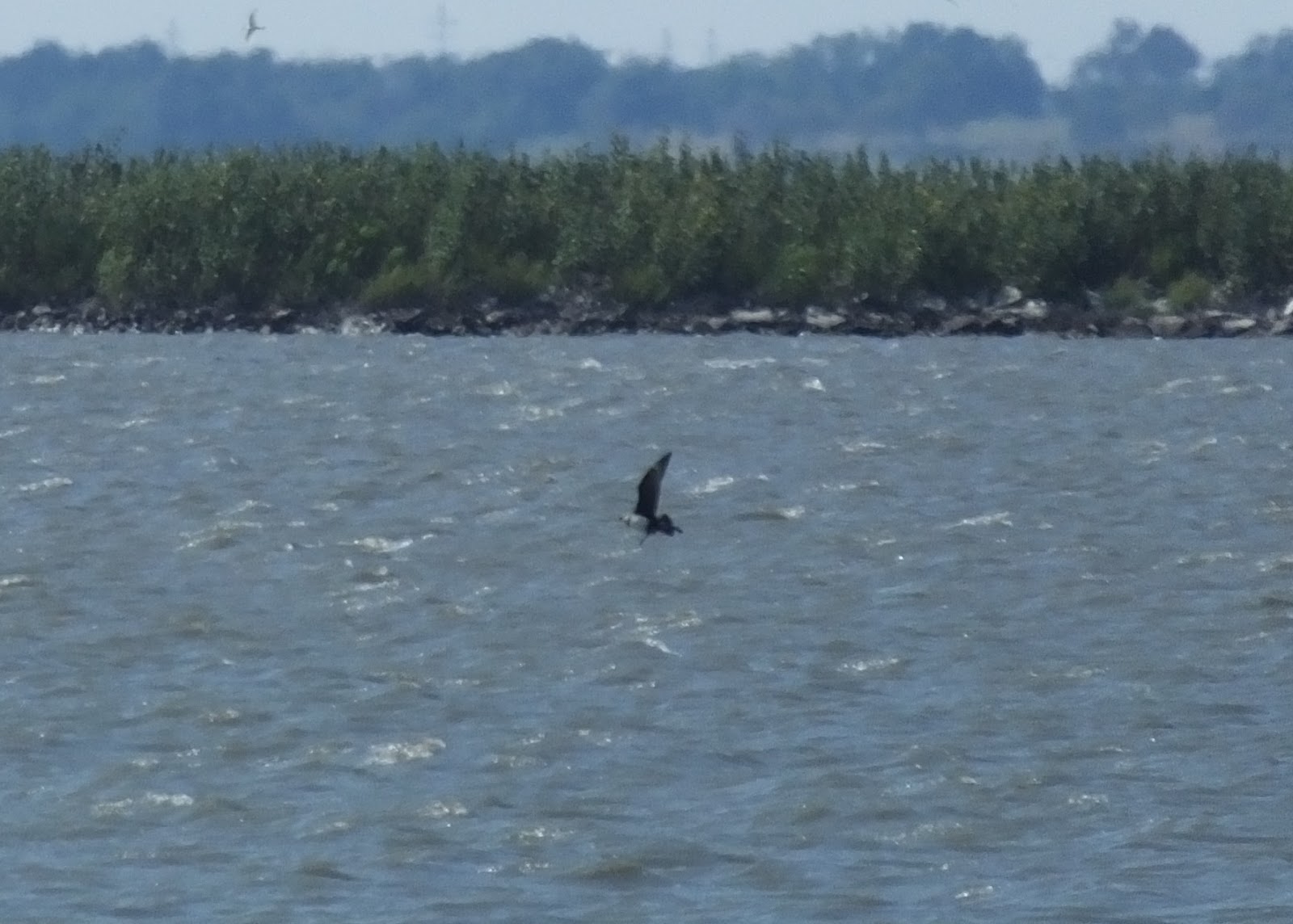
We continued back around the lake, stopping occasionally to scan.  While we did find a Least Bittern, several Buff-breasted Sandpipers, and two Sanderlings, all good finds; the real prize eluded us.  And our time was running out!  It was about 3:30, and we needed to leave by 4:00.  We stopped again (we were now back to where it had first been seen) to talk to some more birders, who told us they had seen the Jaeger about an hour ago from the same place.  It had been back while we were gone around the lake!  While I was still talking to them, Andrew, who had been scanning the lake, sounded the alarm.  Sure enough.  There it was in all its glory, floating on the water about 3/4 of a mile off the shore.  We soon had Edward's scope focused in on it, giving us beautiful looks.  It even took off for us several times, allowing us to see the diagnostic Pomarine paddle-shaped tail.


Pomarine Jaeger: photo by Andrew


Pomarine Jaeger, notice the odd paddle shaped protrusion for the end of the tail: photo by Andrew

What a great finish to a twitch!  It was very gratifying to finally see the crazy critter after several near misses!

Bryant


Wednesday, August 19, 2015

Black-chinned Hummingbird

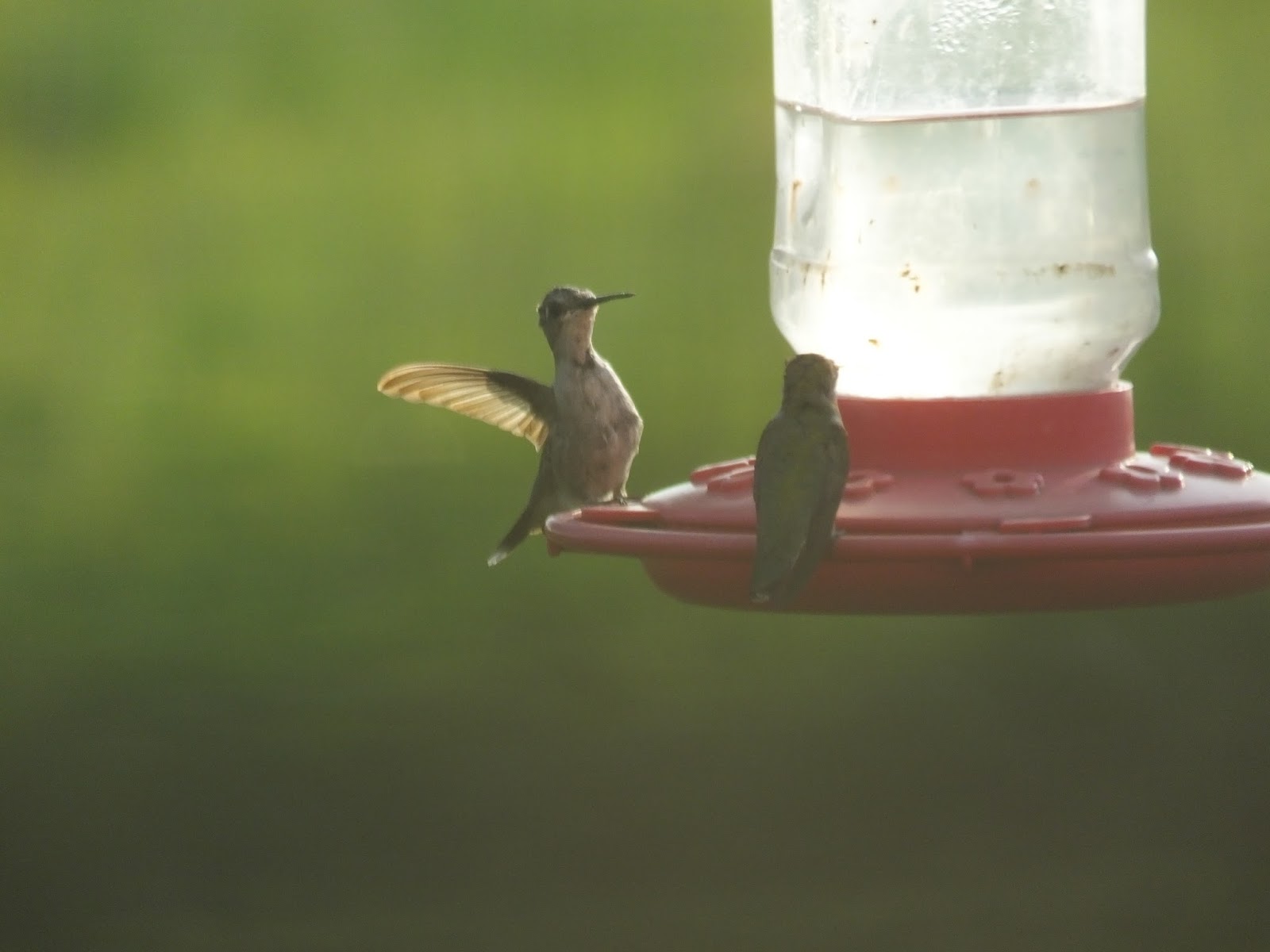
I had an interesting female Archilochus hummingbird start coming to my feeder about a week ago and since they are very tricky to identify, I asked hummingbird expert Sheri Williamson what she thought.  I was elated when she emailed back and said that it was a Black-chinned, since there are under twenty state records. (And nearly all of the other records have been from far western Kansas.)

Black-chinned Hummingbird (left)
Black-chinned Hummingbird.  Notice the "clubbed" look to the wing that separates it from the more common Ruby-throated.

Migration is finally starting to pick up again, and I am very ready for it!  I saw at least two, probably more, Alder Flycatchers near here the other morning.  I had never seen an Alder before this year, and now I have seen five!

Alder Flycatcher


Several weeks ago I saw this Oriole that definitely at least has some Bullock's influence.

Oriole

I have also managed to get a few butterfly pictures, although there haven't many around of late.

Delaware Skipper
Pearl Crescent
Southern Cloudywing


I'll finish with this Dickcissel picture.

Dickcissel

Andrew


Monday, August 17, 2015

Quivira NWR on August 16th

 Joseph texted me after church on Sunday and asked if I wanted to go to Quivira with him and Anthony.  It did not take long for me to figure out that I did, and we set about getting plans laid.  
    We got to Quivira at about 3:00 and headed to the Big Salt Marsh right away.  Anthony had just got a new camera, and he was eager to try it out.  When we got to the east side of the marsh, we found it loaded with shorebirds and ducks.  We picked out two Red-necked Phalaropes almost right away, feeding close to the shore.  We tried to get closer and were quite disappointed when they flew.  Luckily though, they circled back around and came right back to the same spot!  The cameramen quickly, although not very quietly, crawled down on to the shore while the rest (Dwight, Franklin, and Michael) stayed up on the road.  Shutters clicked madly as they made their way by us, not more than ten feet away!  When they were past, we got up feeling rather smug and continued on our way.  After our first loop, we came back and manged to get some more pics of one of them.

Red-necked Phalaropes flying in.

Red-necked Phalarope

Red-necked Phalarope up close
                           
Red-necked Phalarope

Red-necked Phalarope
       
     They were loads of peeps, but the most numerous bird was definitely the American Avocet.  Their bold black and white pattern was quite striking when they flew.

Part of an Avocet flock
        
We also managed to pick out this Western Sandpiper out of a small flock of peeps.
     
This Western Sandpiper was horribly backlit

We saw several of these Dragonflies on the Wildlife Loop.  I don't know what kind for sure, but I think Halloween Pennant is close.  Do any of you know?

Halloween Pennant?

At this time of year there are also large numbers of Snowy and Great Egrets.

Great and Snowy Egrets

This female Blue-winged Teal was cooperative.

Blue-winged Teal

As was this Sachem.

Sachem
I hadn't been to Quivira for a while and I am always amazed how many birds are there at this time of year!

Andrew


Monday, August 10, 2015

Louisiana Waterthrush, A Reno County Nester?

This morning my dad and I were measuring a roofing job near Sylvia when I heard a loud and unfamiliar call coming from a nearby spring-fed swamp.


Luckily I had my birding gear along and trotted over to check it out. I was really surprised when a waterthrush popped out in response to my pishing. I assumed it would be a Northern Waterthrush (even though this would be near record early), but I was surprised to see its broad white "eyebrows" flaring out behind the eye, whitish underparts and an nearly unmarked throat. This was obviously a Louisiana Waterthrush!


Louisianas are fairly common in eastern Kansas, but are very scarce in the rest of the state. (This was a first county record.)

Per usual, my camera focused skillfully on the twig in the foreground when the waterthrush turned broadside. It would have been a nice pic...

Louisianas nest as near by as eastern and extreme southern Kansas, but are typically found near clear, fast-moving streams     a habitat not usually found in flat, dry Reno county. This stream, however, while not fast flowing, was crystal-clear. This bird seemed very skittish, skulking along the stream bank, but would vigorously chase other birds off other birds that came too near. This territorial behavior makes it seem possible it was nesting nearby. I thought I heard a second bird calling at one point, which would make this seem more likely.

The habitat where I found the waterthrush


Butterflies have been pretty slow lately, other than a few Least Skippers I saw while tracking down the waterthrush. I did find a Pipevine Swallowtail (county lifer!) the other day as well as this cooperative Goatweed Leafwing that teed up nicely on a willow twig.


Joseph

Monday, July 20, 2015

Strays from the South: Sisters and Sickle-wings, Oh My!

Butterflies are on the move! 

I was planning to go butterflying with Anthony yesterday afternoon, but had some other stuff come up and wasn't able to go after all.  He called presently with the news that he had found what he thought was a White Admiral. That would be really remarkable here, so I immediately hopped in the truck and hurried the two miles to where he was. When I saw the butterfly I knew it was not a White Admiral, but some sort of "sister" (Adelpha sp)! I didn't know what species, but no sisters are expected here. Luckily it was very tame and allowed us to get some great photos, confirming it as an Arizona Sister, apparently only the sixth record for Kansas! (per Butterflies and Moths of North America Online, BAMONA for short)


Arizona and California Sisters  are very similar. We determined this was an Arizona because of the pale edging all along the back of the white stripe on the hindwing as well as the single orange bar near the base of the wing. A California Sister would have an incomplete pale edge and double orange bars near the wing base. BAMONA staff verified our identification.

This is definitely one of the most beautiful butterflies I've seen. With a 3-5 inch wingspan, it was an impressive sight as it glided slowly around my head, with an occasional flap thrown in now and then.


Anthony and I had also done a little butterflying together after church earlier in the afternoon. Not far away, we found a Red-banded Hairstreak, a species we definitely did not expect here, although isn't nearly as rare as the sister.

Red-banded Hairstreak

A couple of weeks ago, Anthony photographed a butterfly he couldn't identify. When he showed me the photo I recognized it as a Sickle-winged Skipper, which I knew would be really rare here. (I honestly didn't even know if they'd been seen in Kansas before.)


Great pic courtesy of Anthony Miller
I checked the range map on Butterflies and Moths of North America and it appears that it is the third state record! Unfortunately it was a one day wonder, so no one else got to see it.


Another butterfly of interest I've seen lately is this Southern Dogface, a really striking sulphur I'd never seen well before.


I didn't remember they had such stubby antenna.

 They really get flashy in flight, with their bold black and yellow pattern.


If you're thinking about getting into butterflies, now would be a great time to start! As I've mentioned previously, Butterflies of Oklahoma, Kansas, and North Texas is a great reference for learning the butterflies of this area.  For more advanced butterfliers, check out the Kauffman Field Guide to Butterflies of North America. I'll end with a shameless plug. If you want to see more of our butterfly (and bird and mammal) photos you can check out our Flickr photostreams. Mine here, and Bryant and Andrew's here.

Joseph

Tuesday, July 7, 2015

India 2015 | Part One: Kolkata

This spring I had the opportunity to accompany my father on a short trip to India. Needless to say, I was very excited about this chance to visit another part of the world! This is the first (brief) post I'm writing about our trip.

After many hours of traveling, we arrived in Kolkata late on the evening of April 22. After having some hassle involving our luggage not making it with us, we headed to our hotel. We had a connecting flight the next morning, so although I didn't have much time, I woke up early, eager to see what birds I could spot from our hotel window. There were quite a few! Common Mynas, House crows and Red-vented Bulbuls were all over the neighborhood. A couple Little Cormorants flew past in the distance, and a Spotted Dove appeared on the rooftop next door.


A Common Myna holds forth.


An inquisitive House Crow


A Spotted Dove

After a quick breakfast of scaldingly spicy curry, we headed to the airport to catch our flight to Dimapur, in the far north-eastern state of Nagaland. We spent the next several days with the Naga people, exploring the villages and learning about their history. I'll write more about our time there in a later post. 

And no, despite our proximity to Nepal during the earthquake, I did not feel it. My dad did, but we felt fortunate that the area we were in was not at all affected.

Joseph