Friday, June 3, 2016

Monsoon Birding, Laughing Gull and Brown Pelican

With an abnormally wet spring so far, Kansas has been having some odd birds.

A Red Phalarope showed up at Quivira one day last week, so we headed out there Sunday afternoon with a small bit of hope that we would be able to refind it. Long story short, we were a day later and a dollar short, our special feature as usual. We did, however, stumble across a Laughing Gull, not a bad find and a state bird for all of us.

The long lanky wings and large bill are a dead giveaway, even without the other supporting plumage features. Photo by Andrew

On Monday evening the extended family of Andrew, Bryant and I had a Memorial Day picnic at Kingman Lake. I was one of the first there and quickly checked the small lake for anything interesting. I had seen a fairly distant something, driving in, that didn't quite fit for any expected birds, so I checked it out right away. Well, it was a Brown Pelican, that was unexpected. While these are nearly annual in Kansas, (and no longer even a review list species), it was surprising to find one on a small state fishing lake and not one of the larger reservoirs.


It stuck around the rest of the evening but never let us get very close.


These first pics were, yeah, not so great, but thankfully we got another chance when Andrew, Anthony and I returned on Thursday evening. This time, it was chilling on a small island with a small flock of American White Pelicans and allowed us to get within about fifty yards

There we go! Photo by Andrew
The Brown Pelican has been observed feeding successfully by plunge-diving (fide Andrew Burnett), so it may remain for awhile. We won't mind if it does!

Anyway, it seems likely that these birds, (and the Black-bellied Whistling Ducks), were brought in by a large storm system that moved through a couple weeks ago. It may have brought other rarities as well, so keep your eyes peeled!

Joseph


Saturday, May 28, 2016

Black-bellied Whistling Duck

This morning, dad and I went to Cheney hoping to see Prothonotary Warblers.  Unfortunately, the water levels, way up with the several inches of rain over the last week, prohibited us from accessing the area where they had been seen in years past.  However, there was a immature male Summer Tanager and a immature male Painted Bunting singing lustily along the road near Deweese Park.

Bad pic of a Summer Tanager
The rest of the lake was pretty quite, so we decided to head over to Newton where there was a pair of Black-bellied Whistling Ducks being seen.  When we got to the place they had been seen, they were nowhere in sight.  They were seen in a housing development area with a small drainage ditch.  The landowners feed some local Mallards and Geese, and this was where they were hanging out.  We drove around the area, trying to see into the willow trees along the ditch.  It was nearly impossible without going on private property.  Finally, we decided to ask two men who appeared to be the landowners about walking back there.  They were extremely helpful and immediately said they could take us back there.  We started walking along the ditch, but could not find them.  We had walked all the way back and we getting ready to go look in some other wetlands around the area, when dad motioned me over.  There, not 30 feet from us were the ducks!  We had walked right past them earlier about 10 feet away, and they hadn't flown.  We took some pics, then told some of the other birders in the area that we had found them.  Everybody got great looks!

Life Bird!

They were gorgeous birds!


Other migration of note over the past couple of weeks included these birds:

This Veery cooperated very nicely for pics. 
Willow Flycatcher

Philadelphia Vireo 
We were surprised to find this Northern Parula around so late in the season.  Maybe it will stay for the summer,
 Also, Joseph and Anthony found a Blackburnian Warbler near their places on the 21st.  Unfortunately, by the time I got there it was too dark to find it.  As a consolation prize, we did find a Alder Flycatcher singing and calling its heart out in the near darkness.  It was my 10th flycatcher species for the day.  The best we have had!

Andrew

Thursday, May 19, 2016

Quivira Big Day, 2016


May 14th dawned not-so-bright and very chilly on six birders at Quivira National Wildlife Refuge--we were taking part in the annual "Global Big Day" with Barry Jones. We started out at about 6:00 A.M. and slowly collected some of the more common species.The weather for this count was definitely less than ideal, overcast and about 39 F, and we had rather low hopes of beating last years record of 154 species.


 The first good bird of the day was this Olive-sided Flycatcher, not counting the Yellow-breasted Chat and Bewick's Wren that refused to cross the road into Stafford County where we needed them.


 This Tree Swallow teed up nicely beside the road.


 We found a pair of Blue-gray Gnatcatchers in the middle of house construction. Here, the female is just leaving after making a few changes to the structure.


The male wasn't super impressed that we were hanging around and kept scolding at us.


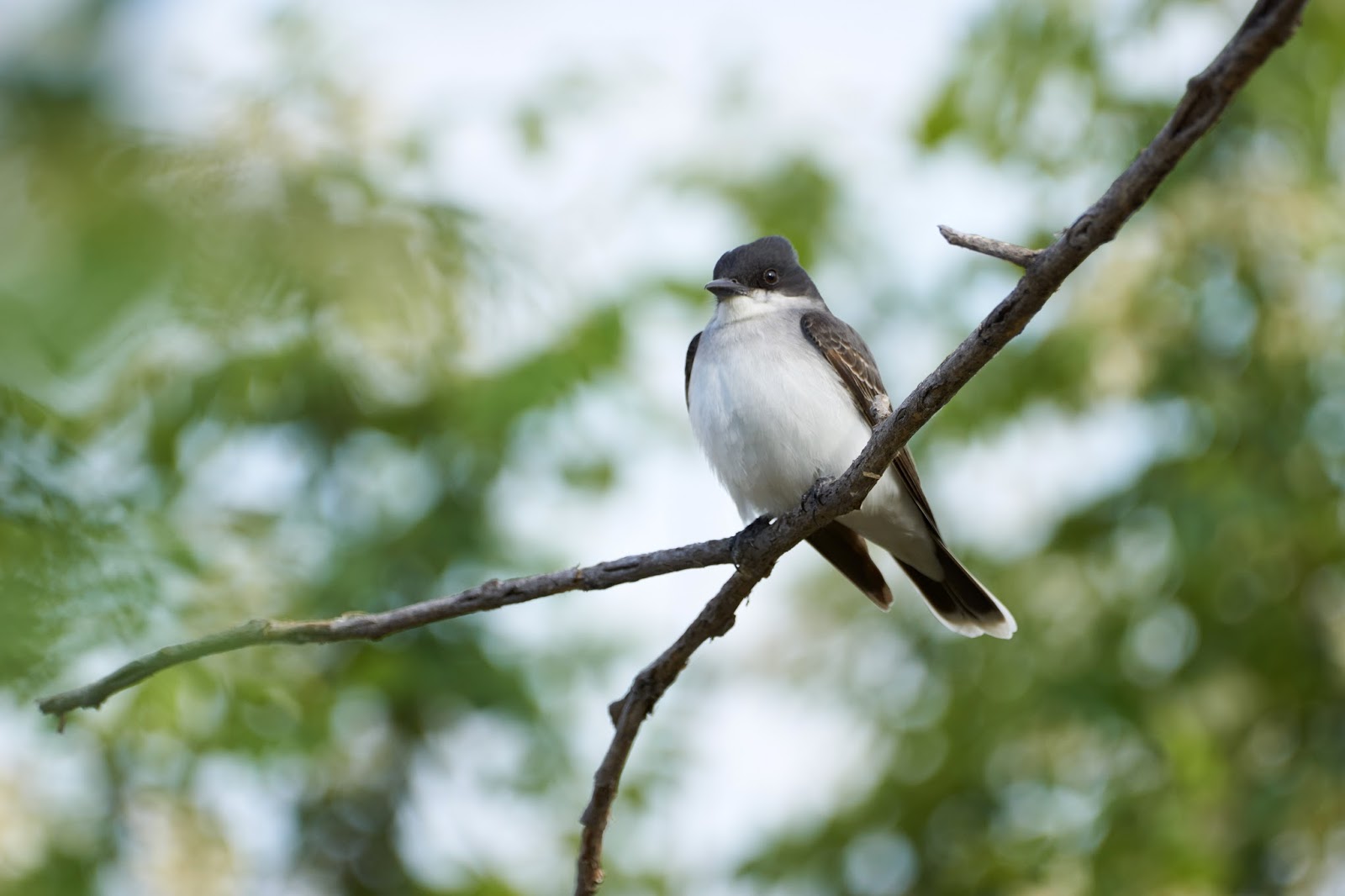
This Eastern Kingbird in the same grove was quite tame, and let me get some nice pics.


After birding a few woodlots, it was time to head to the Big Salt Marsh at the north end the refuge. Here we cleaned up on a lot of shorebirds and waterfowl, including several Sanderling, Dunlin and most of the rest of the "peeps" around right now.


We came upon this American Bittern standing stock-still in the ditch. It was under the impression that it was invisible and slowly backed into the grass.


This Red-headed Woodpecker popped up while we were watching several Bobolinks at the Black Rail field


 A couple of Black-bellied Plovers were a nice addition to the list, and two Whimbrel a bit later were even nicer.


We then hit a couple more woodlots, finding a few more species including Eastern Wood Pewee, American Redstart and Swainson's Thrush.


We also found this caterpillar, I think that it is probably a Variegated Fritillary cat, but I'm not 100% sure on that


The Catalpa Grove
One last swing by the Big Salt Marsh and a nearby Prairie Dog town netted us two Burrowing Owls, a couple Short-billed Dowitchers and a Belted Kingfisher.


Burrowing Owls have got to have about the weirdest flight style of any bird, it's an exaggerated, swooping bounce.

Wilson's Phalarope

We left the refuge with 129 species, below last year but not too bad. We stopped at a few of our regular spots back home to clean up on a few common species we had missed earlier.


This Lark Bunting was a very nice surprise.


This Western Meadowlark sang from a nearby fence post.

Killdeer

I finished the day with 141 species, not bad for this year and enough to have me finish in the top 100 birders for the day in the United States, although just barely, at #98. Anthony also had 141, but Andrew missed out on a few species we saw later and finished up with 136.

All in all, it was a very enjoyable day, and we're definitely looking forward to next year!

Joseph


Wednesday, May 4, 2016

The Great Dip

We had been making plans to go to Quivira/Cheyenne Bottoms for a while, and then a White Ibis showed up at CB on Saturday afternoon.  So, we headed up right after church and got to Quivira at around 1:00.  We birded at various locations as we worked our way up to the Big Salt Marsh.  Nothing produced much, but when we got to the Wildlife Drive stuff started picking up.  We saw three Dunlins and lots of Snowy Plovers that had inhabited the road.  We also saw three Piping Plovers, a threatened species, one of which was flagged and banded.


Edit: Turns out it was banded last summer in North Dakota!

We submitted the tag number, so hopefully we will know soon where it came from.


8N9 is the magic combination.


A better looking individual.
I always enjoy seeing Sanderlings!

We headed out NE 170th St. to head to CB, being only briefly interrupted by a Pileated Woodpecker.  A first for us in Stafford County!

Pileated Woodpeckers are definitely expanding their range farther North and West.

On our way up, we learned that our friend Barry Jones had just been up to CB and had not seen the White Ibis.  This slightly dampened our spirits, but we decided it was still worth the extra 20 minutes of driving.

When we got there, we checked around for the Ibis for a while.  We didn't find it, so we decided to bird the rest of the refuge.  There were vast numbers of shorebirds and we found several year birds including Western Sandpiper, Marbled Godwit, and Black Tern.

Part of a shorebird flock at Cheyenne Bottoms.

 We stopped at a short walk-way where there are often rails and sometimes gallinules. I started calling and an aggressive Virginia Rail immediately responded.  I continued calling and it kept coming closer and closer.  Eventually, it came sprinting out in the open!  It moved fast enough that it was hard to keep track of, but we got some decent pics.

Rails are often incredibly hard to see.  About the only way you can see them is to call them out of their thick marsh homes.
Anthony got some really good shots with his better camera.

Photo by Anthony Miller


Finally we had to leave without having seen the ibis, but when we were just about home, I got an email saying that someone had just spotted the White Ibis bedding down for the night!  It was about four miles from where it had been seen last.  We were disappointed, but agreed that the other finds made the trip well worth it.  My year list is sitting at 210 species and Joseph has 202.

Andrew

Friday, April 29, 2016

Looking into the crystal ball, Kansas' Next Ten Birds.


Part of the fun in birding is trying to predict what is going to show up where. While it is often guessing as much as actual prediction, you can be surprisingly accurate, and it's fun when you are actually correct. I've had a Top Ten Next-up Birds for Kansas list, (really more of a top thirty next birds, I went way out) for a while, and have been lucky enough to actually have a few of my predictions come true. I convinced Andrew to come up with a list of his own, so that we could post them here for all to see.


So, without further ado, here are our predictions for the next ten birds to be added to the Kansas state list. You may notice that there are actually thirteen species in the first list, due to my including my successful predictions (in bold) as well.

1. Eurasian Tree Sparrow. March 19, 2016. Doniphan Co. Pending acceptance
 
2. Pacific Wren. Dec 20, 2014 Scott Co. Accepted by the KBRC

3.Slaty-backed Gull. A  fairly regular vagrant into the interior of the continent.
4.  Pacific-slope Flycatcher. Probably overlooked in western Kansas.


Tropical Kingbird. This one from Costa Rica, not Kansas


5. Tropical/Couch's Kingbird. History of straying

6.  Sharp-tailed Sandpiper. Overdue in my opinion, neighboring states have multiple records.

Sharp-tailed Sandpiper eBird sightings map

 
7.  Common Black Hawk. One recent unconfirmed report. Likely to be found in extreme south-west Kansas but could show up anywhere.

8. Blue-throated Hummingbird. Several reports already, only a matter of time for a confirmed one. 

9.  Black Swift. Swifts are highly migratory and this species breeds within a few hundred miles.
  
10. Grace's Warbler. One unaccepted report already, I think?
  
11. Black-chinned Sparrow. Breeds not far away in north-east Arizona. Morton County somewhere?  

12. Purple Sandpiper. December 23, 2015. Russell Co. Accepted by the KBRC

13. Acorn Woodpecker. Breeds within a couple hundred miles. 


And here is Andrews list. We agreed on a lot of species, but he has some likely ones I hadn't thought of. It will be interesting to see who is more accurate in the long run.


1. Slaty-backed Gull

Slaty-backed Gull eBird sightings map


2. Bar-tailed Godwit

3. Black-chinned Sparrow

4. Zone-tailed Hawk

5. Black-tailed Gull

6. Sharp-tailed Sandpiper

7. Common Black Hawk

8. Blue-throated Hummingbird

9. Golden-crowned Woodpecker

10. Lawrence's Goldfinch


Will any of these actually be the next on the list? It's impossible to say, but I like to think that at least a couple of these predictions will come true. What do you think the next first state record will be? Leave you guesses in the comments below and we will see what shows up!

Joseph


Monday, April 11, 2016

Chickens and Curlews

A few days ago, Andrew, Anthony, Bryant, Michael Yutzy and myself finally made the trek down to southern Kansas to look for Lesser Prairie Chickens, a gaping hole on our state list.


Photo by Andrew

After cruising down some very bad back roads, we finally arrived at the lek just before sunrise. We could see several males actively lekking a couple hundred yards of the road right as we pulled up,  at least that was an easy lifer.


 Since it was still fairly early in the morning when we left, we decided to run over to the Sun City area to check the area of the Anderson Creek Fire.

It turned out to be a great decision, starting with a Burrowing Owl we found just down the road from the lek, chilling in a Prairie Dog town.

Photo by Andrew

We continued on, finding a clump of balloons originating in Colorado Springs, and more importantly, a pair of Red-shouldered Hawks and couple of Long-billed Curlews in a random wheat field beside the road.

Photo by Andrew
Had the hawks been a couple miles further west they would have been a new Kiowa County record.

One of two Long-billed Curlews. Photo by Andrew

When we got to Sun City we were impressed by the amount of fire damage that far north. I knew about where I had taken some landscape shots last summer and thought it would be kind of fun to get a before and after shot of the burned area.

Before the fire


And after the fire. I was surprised how close I actually got to the same view!


More burned prairie south of Sun City

We decided to stop in at Kingman State Fishing Lake on the way back home. Birdwise it was a little drab, but we did find a female Falcate Orangetip, a lifer for all of us.

Falcate Orangetip, note the hooked, "falcate," wingtip.

This is a really amazing looking butterfly, although a lot smaller than I expected.  They are very well camouflaged on the underside, so we would occasionally lose it when it landed.

Falcate Orangetip


There were also several Olympia Marbles flying about. Although these are my best photos so far, I still haven't quite gotten that perfect shot yet

Olympia Marble


It was a great morning out, and we definitely plan to do more of these outings to other parts of the state.

Joseph