Thursday, October 22, 2015

First State Record!!

Yesterday morning I found an interesting skipper in the lavender plants by our front porch.  When I saw it I immediately knew that it wasn't anything I had ever seen before.  The first thing that came to mind was Ocola Skipper, but I wasn't sure.  I took a bunch of pictures and then went inside to check it out.  Turns out, it was indeed an Ocola!  This is the first Kansas record and also the first record from the genus Panoquina!  Joseph came over after school and managed to see it, but unfortunately it was gone when Bryant and I got home a little later.

Ocola Skipper

Ocola Skipper

Ocola Skipper

While Bryant and I were trying to refind it, we did found this Skipperling.  It appears to just be a Orange Skipperling, but the upperwings look similar to a Southern Skipperling, which would be another first state record!

Skipperling sp.

Skipperling sp.

The strong south winds around here for the last couple of days probably brought many stray butterflies up here.  Joseph also had a Texan Crescent and a Bordered Patch at his place this evening, both southern butterflies.  Hopefully all the southern stuff hangs around for several days.  

I haven't done much birding lately, but I have seen some good stuff in the little that I have done.

This Killdeer was killed and impaled by a Shrike.

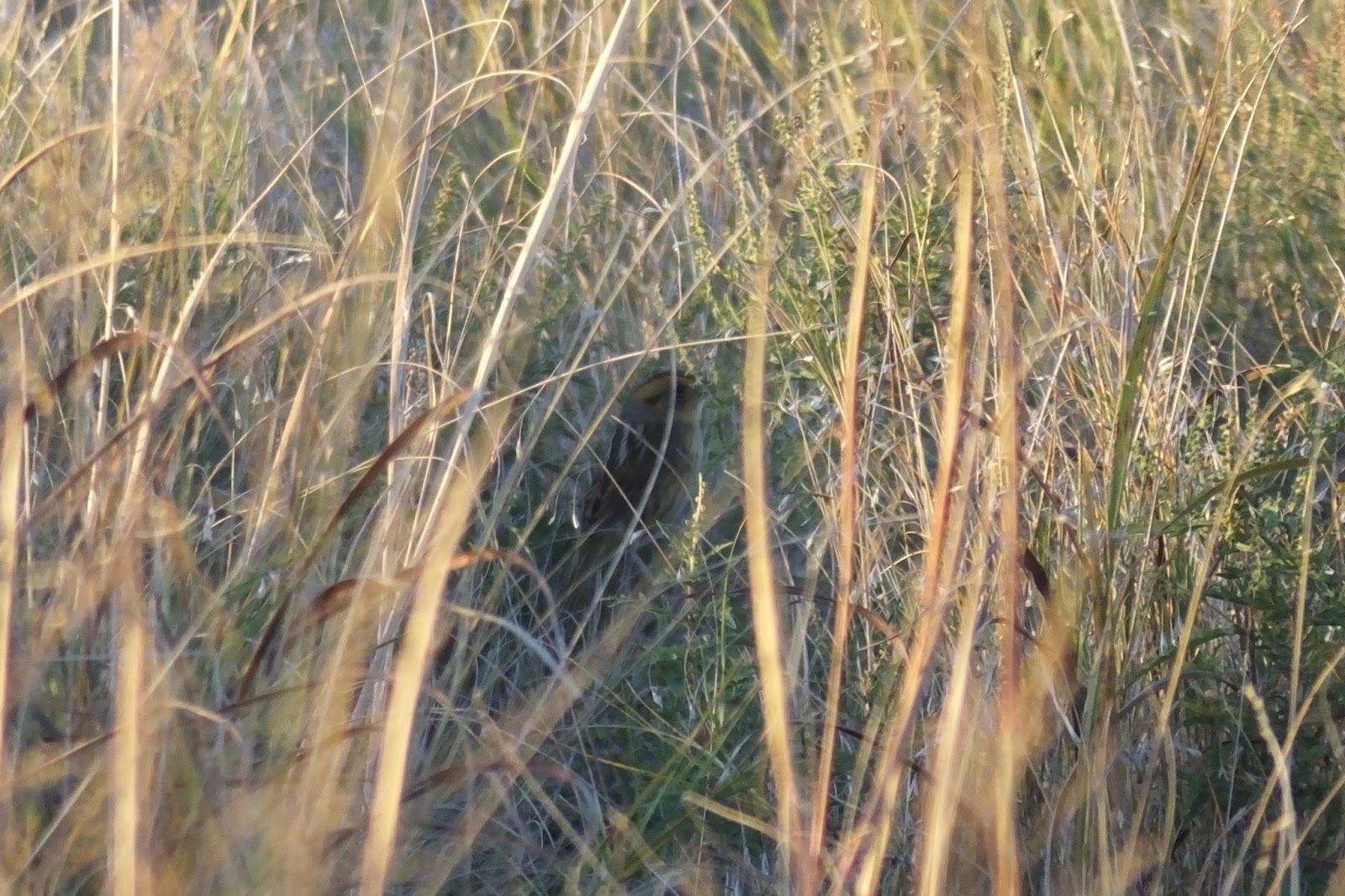
One of the Nelson's Sparrows that hung around the Sparrow stretch for several days.

Vesper Sparrow in the morning light.

Short-eared Owl against the sunset.  This was year bird #264!

I also had two Common Redpolls in the yard about two weeks ago.  They were lifers, but unfortunately I didn't get any good pictures.  They were also the earliest seen in Kansas by a week!  All in all, it has been a good fall!

Andrew


Saturday, October 10, 2015

A Sixteen Sparrow Saturday

A Marsh Wren in the early morning light
I made the discovery last evening that a weedy dead-end road nearby (which we affectionately refer to as "the sparrow stretch") was thick with sparrows and wrens. I ended up with ten species of sparrows including my first ever Nelson's Sparrow! I was not able to get any good photos of it, however, so I was back before sunrise this morning.


 The first good sparrow I found was this very confiding Le Conte's. It calmly sat on the wire as I stalked up.

Uh...Ahem there!

Dwight and Anthony soon showed up and we started looking seriously for the Nelson's. We weren't finding them where I had seen it last night, so we stumbled through the adjacent CRP field in search of more. There were indeed Nelson's there! We estimated at least ten of them, along with a few additional Le Conte's and a handful of Marsh and Sedge Wrens.


True to form the Nelson's kept very well hidden,  allowing us only a few decent shots.


I was fascinated to hear the the flight calls of both the Nelson's and Le Conte's Sparrows. The Nelson's was distinctly buzzier than the thin, clear call of the Le Conte's.


We had accumulated over a dozen species of sparrows by now and decided to see if we could beat our previous one-day record of fifteen species. A quick check of some sandhill plums thickets revealed a few more; including a nice male Eastern Towhee, only the third I've seen in the county and number sixteen for the day!

A grouchy looking Clay-colored Sparrow
Bryant and Andrew soon came over to look for the Nelson's. Unfortunately the sparrows were fairly uncooperative, and treated us only to brief glimpses in flight.

I think that Nelson's are likely far more common than current records indicate. Their habitat (small patches of cordgrass) is seldom birded at this time of year. So if you have cordgrass nearby, right now is probably your best chance for a Nelson's.

Joseph

Tuesday, September 29, 2015

Eclipse


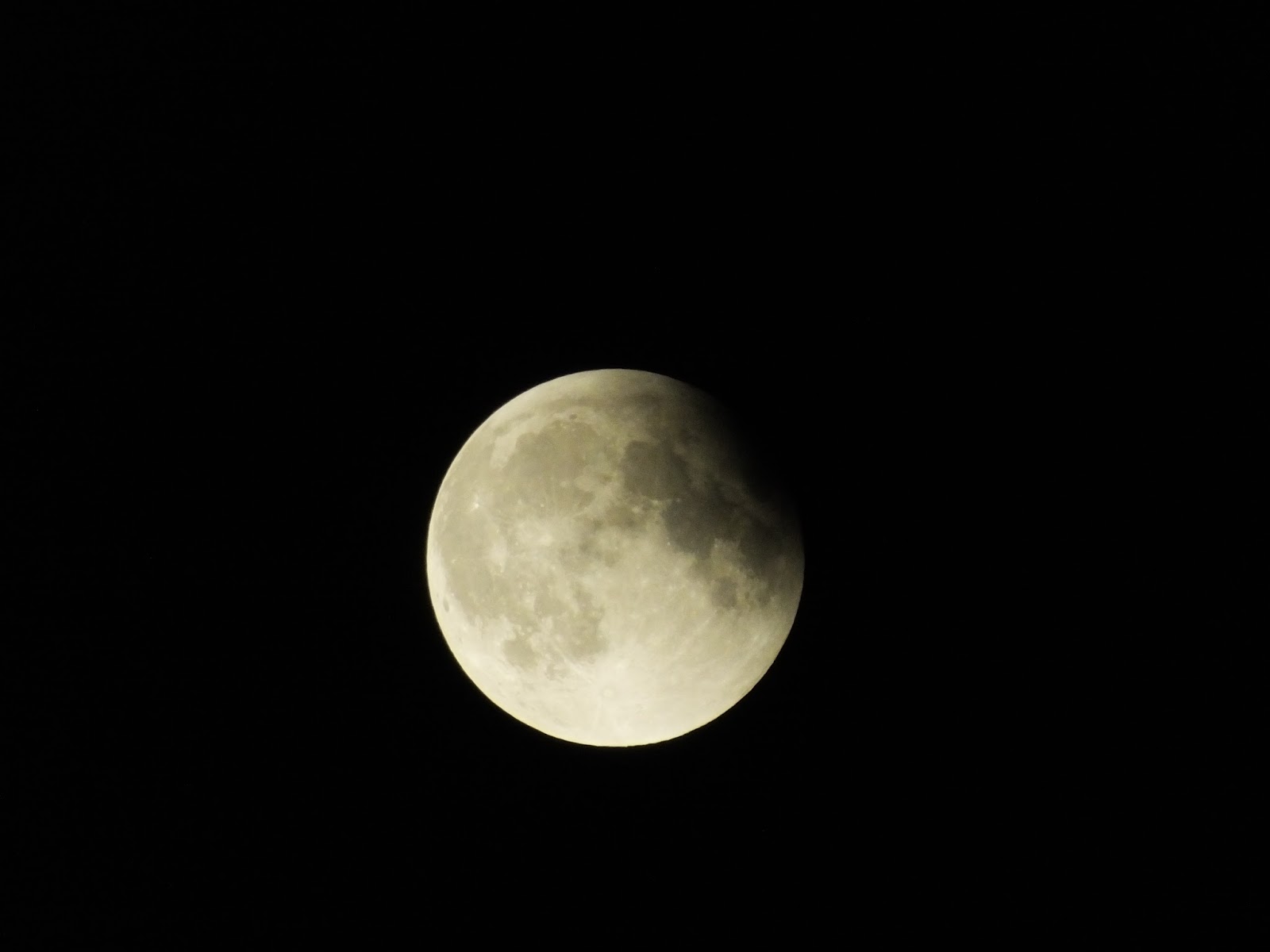
On Sunday night, there was a supermoon combined with an eclipse.  The last time this happened was in 1982 and it won't happen again until 2033.  I decided to go out and take some pictures, but due to a major bone-head move I didn't get any while it was full.  Anyway, here they are!


I now wish I had stayed up until it was completely over, but sleep is important too:)
I think this is only the fourth or fifth eclipse I have ever seen, but this was definitely the most fun one for me!

Andrew

Monday, September 14, 2015

Tails and Terns

When our youth group went camping this weekend at Kanopolis Reservoir Anthony and I jumped at the chance to go birding in a different part of the state.


We arrived fairly late Friday evening and didn't really have a chance to go birding until late Saturday morning, when we recruited another guy to hiking with us on the Horsethief Canyon trail. He soon got tired of following us all over the country and stopped, sensibly, with a magazine to read. Anthony and I continued hiking over very rough terrain, hoping to reach a point in the lake where we had seen a large flock of gulls. After perhaps an hour we got there, only to find that there were only Franklin's and a few Ring-billed Gulls.

Franklin's Gull


 We kept scanning, however, and soon found a small group of terns within the larger flock. Most of them were classic Forster's, with isolated dark eye patches and pale wingtips. There was one in breeding plumage, which struck us as odd, since all the rest were in non-breeding plumage. It soon dawned upon us that it was actually a Common Tern, a lifer!

Common Tern (center). Note the gray belly and extensively dark primaries. Although not apparent in this photo, the bill was dark red with an extensive dark tip. Photo by Anthony

My poor photo of two of the Common Terns. Notice the diagnostic dark carpal bar on the non-breeding individual on the right.


A bit more scanning turned up two more Commons, these in non-breeding or juvenile plumage. In a valiant attempt to get better pics I waded out to my waist, all to no avail as I was still too far away for good photos.


We reluctantly started back, groaning at the fact that we had nearly three miles of hiking to get back to camp. The misery was offset when, part way back, I noticed an unfamiliar butterfly. It was bright orange like a Sleepy Orange, but had black only on the front corners of its wings. I not-so-casually mentioned that it might be a Tailed Orange and sprinted off up the sumac-covered slope to try and photograph it. We soon succeeded and confirmed our suspicions, it was a Tailed Orange! Luckily it was quite cooperative, letting us get great pics.


I encouraged Anthony to try to get flight shots, since it was not markedly different from a Sleepy Orange on the underside. I failed miserably on this, but Anthony was successful in getting some great photos of this seventh state record.

Along with the limited black in the wings, the wing shape is also different from Sleepy Orange. Tailed has distinctly "squared-off" wings, unlike the Sleepy's more rounded wingtips. Photo by Anthony


It seemed that every patch of exposed rock had its own Prairie Fence Lizard. This one sat quietly pondering life, which turned out to be a small grasshopper, which it caught and ate.


Joseph

Thursday, September 10, 2015

Long-tailed Skipper at the Dyck Arboretum!!!

Today I went to the Dyck Arboretum in Hesston to attend a plant sale with my aunt and sister. The first bird I saw was an Olive-sided Flycatcher perched in a dead tree right next to the path.


We had to wait a little while to get in, so I strolled around to look at some butterflies on some nearby blooming shrubs. There were dozens, if not hundreds, of Silver-spotted Skippers all over the bushes so I checked them carefully for something interesting. I glanced over at a Silver-spotted Skipper perched in front of me, "That's not a Silver-spotted Skipper, THAT'S A LONG-TAIL!"  Long-tailed Skippers are NOT expected in Kansas.


 I frantically snapped away for a couple minutes before it disappeared. Despite checking the bush several times throughout the afternoon I was unable to relocate it.


 According to BAMONA (Butterflies and Moths of North America Online) this is only the fourth state record!

Although I wasn't able to get a good photo of the upperside, you can see the characteristic greenish body here that separates it from other longtails


A bit later, while walking the trails, I came upon this Queen nectaring on some asters. Monarchs, at least, seem to be doing well at the arboretum, I found several caterpillars on a Tropical Milkweed plant.

It was a very satisfying afternoon to be out!

Joseph


Wednesday, September 9, 2015

Rufous Delight

I must admit I was a bit doubtful one evening last week when my sister hollered that there was a Rufous Hummingbird at the feeder, but a quick dive to the window confirmed her suspicions. It was indeed an immature male Rufous! I made another dive for the camera, but by the time I was back at the window it had left. I waited patiently and it soon appeared at our other feeder, where I was able to get some decent pics. Yes! A quality year-bird and only the second ever for my yard!


To be honest,  I couldn't confidently eliminate Allen's Hummingbird with these views, but with one previous state record what are the odds?


To my great surprise an adult male Ruby-throated Hummingbird soon joined the Rufous. I have only had three or four Rubies at my feeder this fall so far, so this was a pleasant sight. It was also the first time I have ever had two species of hummers at once!


Andrew and Anthony soon showed up to see their third Reno Co hummer of the fall. (The third was Bryant and Andrew's Black-chinned a couple weeks ago). Luckily for them it was still sitting in the tree when they arrived. Surprisingly, the male Ruby right next to it didn't seem bothered by the Rufous casually sitting a few inches away. More typically, the adult male would have bullied the immature away from the feeder. Perhaps it was just too tired from a long flight. Who knows?

Joseph


Monday, August 24, 2015

Blue-winged Warbler

This morning I woke up early and decided to go birding on Frank Blodgett's land about a mile away from our house.  It was a perfect morning, cool and clear, and I was feeling like it might be a pretty good day for the birds.  When I got the at a little after 7:00, there was a lot of activity.  Unfortunately, most of it was common resident birds.  I was rather disappointed that there were so few birds, and the only thing that was very interesting was a Philadelphia Vireo.  I was watching a Trail's Flycatcher feeding in a locust tree, when a small, bright yellow bird flew in.  I saw that it had white undertail coverts and immediately thought of a Prothonotary Warbler, but I then I saw that it had a black eye-line and blue wings with white wing-bars.  BLUE-WINGED WARBLER!  I frantically began snapping pictures and trying to call Bryant.  It kept feeding in the same tree for a while, and then disappeared.  Luckily though, we were able to find it again when Bryant came.  This is a casual visitant in our area of Kansas and it is on the KBRC review list for this part of the state as well.  Anthony and Michael came down about two hours later, and were able to see it.  Unfortunately, when Joseph came over this evening he couldn't refind it.
  
Blue-winged Warbler
Blue-winged Warbler

Blue-winged Warbler


While we were watching it we found a nice flock that also had Black-throated Green Warbler, a year bird.

Black-throated Green Warbler
I also had a nice Phaon Crescent that posed for me.

Phaon Crescent 
This was only the second Philadelphia Vireo I have seen in Reno.

Philadelphia Vireo
Hopefully this good birding continues!

Andrew