Showing posts with label Quivira. Show all posts

Wednesday, October 5, 2016

Sabine's!

After school today, Joseph, Bryant, and I went on a quick run to Quivira hoping to see the Sabine's Gulls that had been recently reported. On arriving at the east side of the Big Salt Marsh we found a nice flock of 16 Red-necked Phalaropes.  When we got to the main lake, we were impressed to see thousands of coots covering the water. Their wings made an impressive roar whenever they took off.  We then started scoping the massive flock of Franklin's Gulls for Sabine's with no success.  Then I quick glassed out to the south of where we were and almost immediately saw a Sabine's Gull!  We soon found that there were three present and we got decent looks, even though they were pretty far out.

Bad pic of a Juvenile Sabine's Gull.  Note the distinctive wing pattern

All three in one pic

While we were watching the gulls, several flocks of American Golden-Plovers flew over, year birds for Joseph.  We left the Big Salt Marsh briefly and headed to the Black Rail Field where we heard a Sedge Wren (a year bird for me) and a Virginia Rail calling.  We decided to stop by the Big Salt Marsh again before we headed home, and the Franklin's Gull numbers were amazing!

Some of the Franklin's Gulls
There was also a continuing Lesser Black-backed Gull hanging around.  Although they are sometimes seen in the summer, they are much more common in the winter.

Third cycle Lesser Black-backed Gull
I always love this time of year, when all the winter birds are just showing up and the late migrants are in full swing!

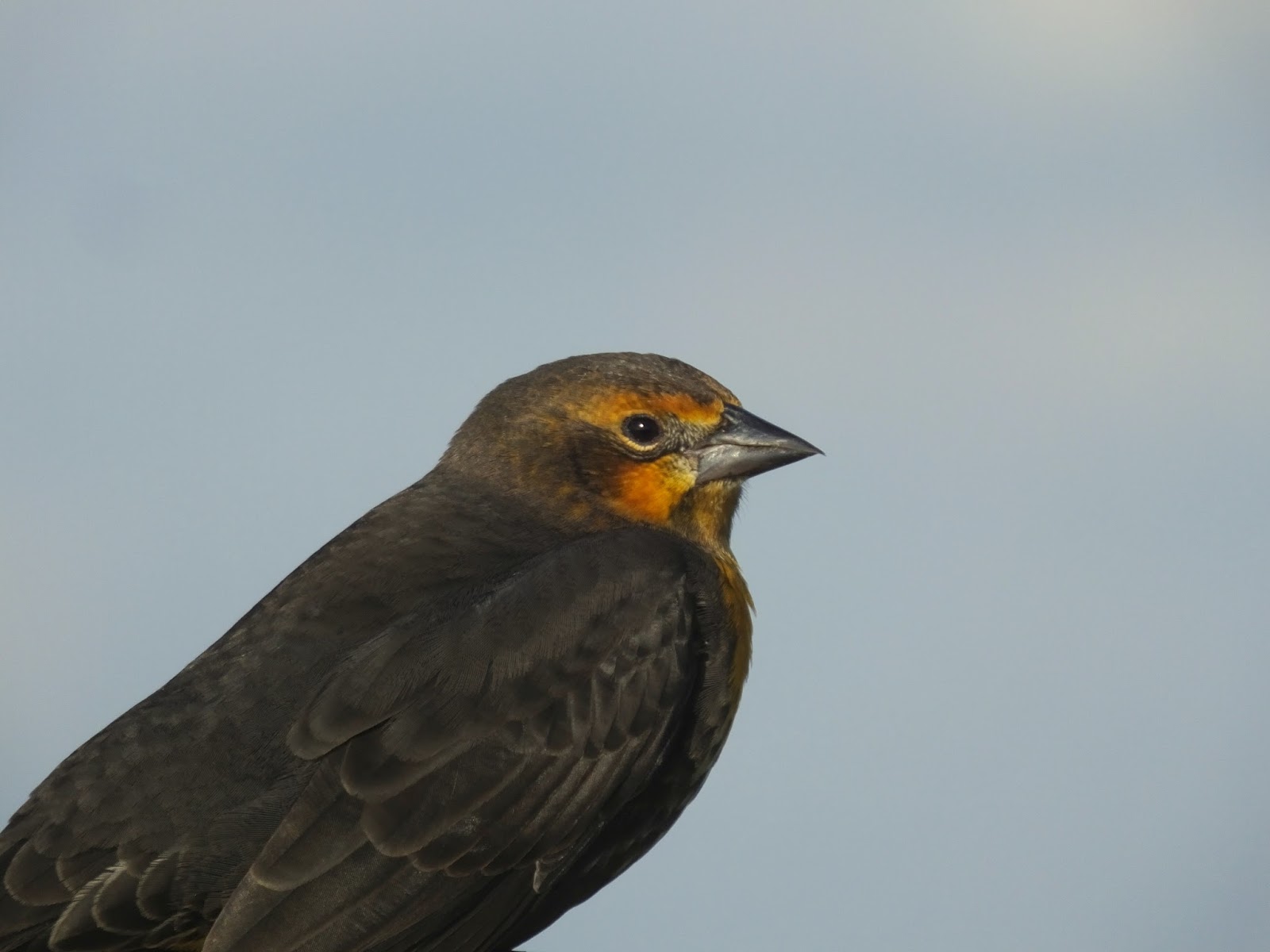
This female Yellow-headed Blackbird posed nicely

 Andrew


Friday, June 3, 2016

Monsoon Birding, Laughing Gull and Brown Pelican

With an abnormally wet spring so far, Kansas has been having some odd birds.

A Red Phalarope showed up at Quivira one day last week, so we headed out there Sunday afternoon with a small bit of hope that we would be able to refind it. Long story short, we were a day later and a dollar short, our special feature as usual. We did, however, stumble across a Laughing Gull, not a bad find and a state bird for all of us.

The long lanky wings and large bill are a dead giveaway, even without the other supporting plumage features. Photo by Andrew

On Monday evening the extended family of Andrew, Bryant and I had a Memorial Day picnic at Kingman Lake. I was one of the first there and quickly checked the small lake for anything interesting. I had seen a fairly distant something, driving in, that didn't quite fit for any expected birds, so I checked it out right away. Well, it was a Brown Pelican, that was unexpected. While these are nearly annual in Kansas, (and no longer even a review list species), it was surprising to find one on a small state fishing lake and not one of the larger reservoirs.


It stuck around the rest of the evening but never let us get very close.


These first pics were, yeah, not so great, but thankfully we got another chance when Andrew, Anthony and I returned on Thursday evening. This time, it was chilling on a small island with a small flock of American White Pelicans and allowed us to get within about fifty yards

There we go! Photo by Andrew
The Brown Pelican has been observed feeding successfully by plunge-diving (fide Andrew Burnett), so it may remain for awhile. We won't mind if it does!

Anyway, it seems likely that these birds, (and the Black-bellied Whistling Ducks), were brought in by a large storm system that moved through a couple weeks ago. It may have brought other rarities as well, so keep your eyes peeled!

Joseph


Thursday, May 19, 2016

Quivira Big Day, 2016


May 14th dawned not-so-bright and very chilly on six birders at Quivira National Wildlife Refuge--we were taking part in the annual "Global Big Day" with Barry Jones. We started out at about 6:00 A.M. and slowly collected some of the more common species.The weather for this count was definitely less than ideal, overcast and about 39 F, and we had rather low hopes of beating last years record of 154 species.


 The first good bird of the day was this Olive-sided Flycatcher, not counting the Yellow-breasted Chat and Bewick's Wren that refused to cross the road into Stafford County where we needed them.


 This Tree Swallow teed up nicely beside the road.


 We found a pair of Blue-gray Gnatcatchers in the middle of house construction. Here, the female is just leaving after making a few changes to the structure.


The male wasn't super impressed that we were hanging around and kept scolding at us.


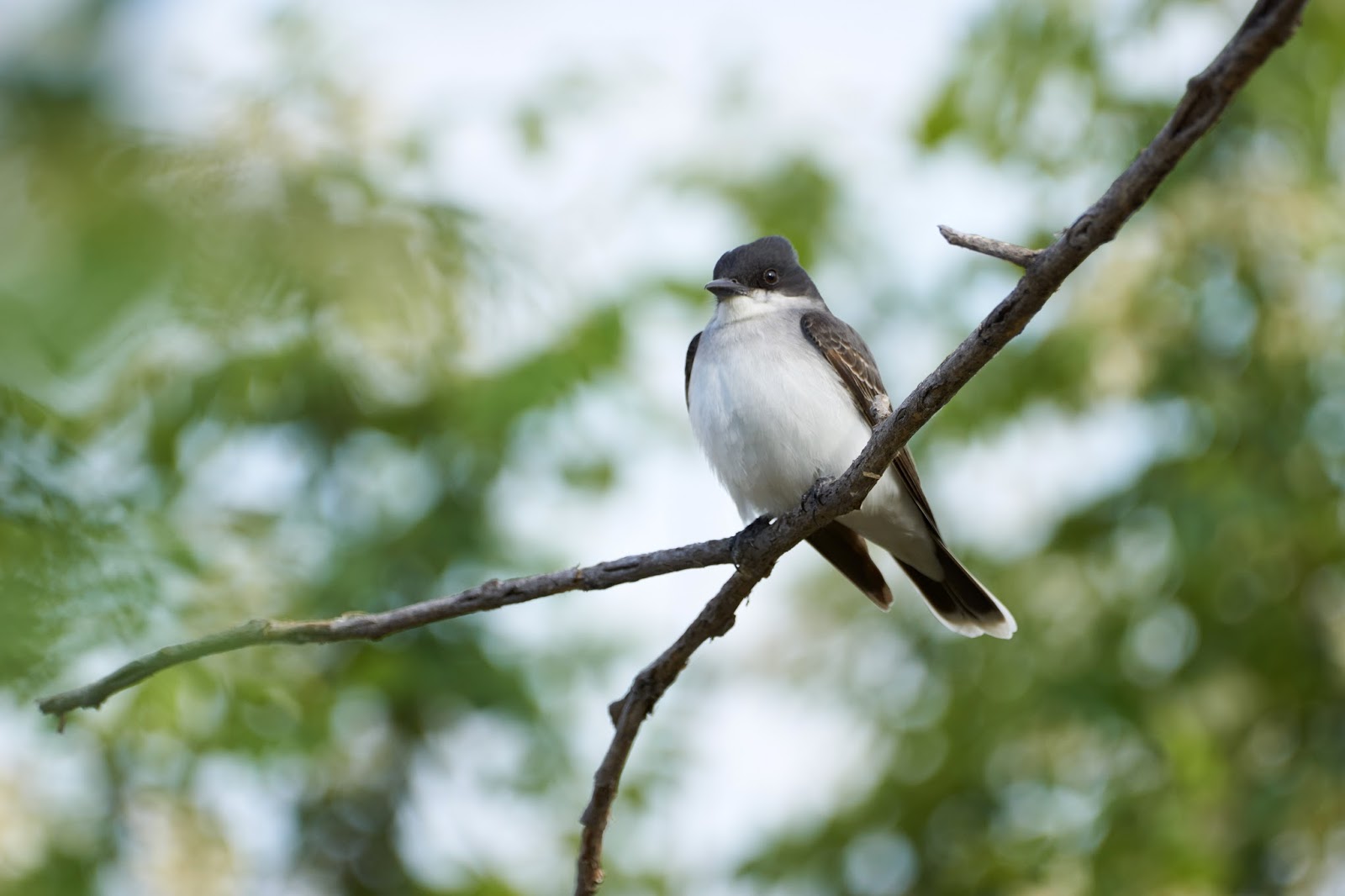
This Eastern Kingbird in the same grove was quite tame, and let me get some nice pics.


After birding a few woodlots, it was time to head to the Big Salt Marsh at the north end the refuge. Here we cleaned up on a lot of shorebirds and waterfowl, including several Sanderling, Dunlin and most of the rest of the "peeps" around right now.


We came upon this American Bittern standing stock-still in the ditch. It was under the impression that it was invisible and slowly backed into the grass.


This Red-headed Woodpecker popped up while we were watching several Bobolinks at the Black Rail field


 A couple of Black-bellied Plovers were a nice addition to the list, and two Whimbrel a bit later were even nicer.


We then hit a couple more woodlots, finding a few more species including Eastern Wood Pewee, American Redstart and Swainson's Thrush.


We also found this caterpillar, I think that it is probably a Variegated Fritillary cat, but I'm not 100% sure on that


The Catalpa Grove
One last swing by the Big Salt Marsh and a nearby Prairie Dog town netted us two Burrowing Owls, a couple Short-billed Dowitchers and a Belted Kingfisher.


Burrowing Owls have got to have about the weirdest flight style of any bird, it's an exaggerated, swooping bounce.

Wilson's Phalarope

We left the refuge with 129 species, below last year but not too bad. We stopped at a few of our regular spots back home to clean up on a few common species we had missed earlier.


This Lark Bunting was a very nice surprise.


This Western Meadowlark sang from a nearby fence post.

Killdeer

I finished the day with 141 species, not bad for this year and enough to have me finish in the top 100 birders for the day in the United States, although just barely, at #98. Anthony also had 141, but Andrew missed out on a few species we saw later and finished up with 136.

All in all, it was a very enjoyable day, and we're definitely looking forward to next year!

Joseph


Monday, August 17, 2015

Quivira NWR on August 16th

 Joseph texted me after church on Sunday and asked if I wanted to go to Quivira with him and Anthony.  It did not take long for me to figure out that I did, and we set about getting plans laid.  
    We got to Quivira at about 3:00 and headed to the Big Salt Marsh right away.  Anthony had just got a new camera, and he was eager to try it out.  When we got to the east side of the marsh, we found it loaded with shorebirds and ducks.  We picked out two Red-necked Phalaropes almost right away, feeding close to the shore.  We tried to get closer and were quite disappointed when they flew.  Luckily though, they circled back around and came right back to the same spot!  The cameramen quickly, although not very quietly, crawled down on to the shore while the rest (Dwight, Franklin, and Michael) stayed up on the road.  Shutters clicked madly as they made their way by us, not more than ten feet away!  When they were past, we got up feeling rather smug and continued on our way.  After our first loop, we came back and manged to get some more pics of one of them.

Red-necked Phalaropes flying in.

Red-necked Phalarope

Red-necked Phalarope up close
                           
Red-necked Phalarope

Red-necked Phalarope
       
     They were loads of peeps, but the most numerous bird was definitely the American Avocet.  Their bold black and white pattern was quite striking when they flew.

Part of an Avocet flock
        
We also managed to pick out this Western Sandpiper out of a small flock of peeps.
     
This Western Sandpiper was horribly backlit

We saw several of these Dragonflies on the Wildlife Loop.  I don't know what kind for sure, but I think Halloween Pennant is close.  Do any of you know?

Halloween Pennant?

At this time of year there are also large numbers of Snowy and Great Egrets.

Great and Snowy Egrets

This female Blue-winged Teal was cooperative.

Blue-winged Teal

As was this Sachem.

Sachem
I hadn't been to Quivira for a while and I am always amazed how many birds are there at this time of year!

Andrew


Thursday, June 4, 2015

Cheyenne Bottoms and Quivira on June 1

Last weekend, our uncle Bill from North Carolina stopped by our area to visit family.  Bill is rarely in this area without making a run to Quivira sometime during his stay, and he's usually obliging enough to take his eager nephews along.  At about 5:45 Monday morning, we (Bill, Andrew, Joseph, and I) piled into Bill's minivan and headed to Quivira and nearby Cheyenne Bottoms for a morning of birding.

We headed straight through the Big Salt Marsh to the rail fields at the north-west end of the refuge.  We hopped out of the car to listen and before long, a Black Rail began calling not far away.  With that year bird acquired for Joseph and Bill, we headed back around the Wildlife Drive.  We were surprised to flush a flock of eight Black-crowned Night-herons from among the cattails, but that was the most unusual sighting.

Things began to pick up some when we revisited the road (NE 170th St.) we had passed over quickly on our way to the rail field.  A variety of shorebirds, forced onto the road because of the high water, gave us great looks.  The highlights were eight Sanderling, three of which were in alternate plumage, and a Ruddy Turnstone.


Alternate plumage Sanderling: photo by Andrew


Ruddy Turnstone: photo by Bryant

Having scanned the Big Salt Marsh at Quivira, it was time to head to Cheyenne Bottoms.  We stopped briefly at the Visitor's Center and then headed out into the marsh.  The east side produced very little, and it was only when we got around to the west side that the birds started being more cooperative.  We were driving along scanning the marsh, when Andrew yelled, "Neotropic Cormorant."  As soon as the van stopped, we all piled out and took a look.  Sure enough, a small cormorant with a long tail was flying away.  Some of us even saw the white line on the edge of the gular patch; certainly a Neotropic.  They nested there last year and appear to be staying the summer this year as well.  Lifer for Bill and a year bird for Andrew and me!


Neotropic Cormorant: photo by Bryant


This Forster's Tern came waltzing by, giving us good picture opportunities: photo by Andrew


A short while later, a small heron-like bird perched on the cattails caught our attention.  The Least Bittern stayed put long enough for us to get pictures.  Another year bird for Andrew, Bill, and me!


Least Bittern: photo by Andrew


Strength in numbers!  Three pairs of Canada Geese and their goslings joined forces.  I'm not quite sure why, but they probably had a reason: photo by Bryant


A closeup of some of the geese: photo by Bryant


We finished our run of the marsh and were on our way out, when Andrew stopped us.  He thought he had a Western Grebe.  As it turned out, it was not just one Western Grebe, but nine!  This was a lifer for Bill and a year bird for Andrew and me.  One pair even treated us to their unique mating dance, in which they run on top of the water with their necks arched!  What a fascinating sight, and also a very unusual one for Kansas.


A pair of Western Grebes: photo by Bryant


What a great day of birding with Uncle Bill!

Bryant

Wednesday, May 27, 2015

Quivira NWR 5-27-15


Bryant and I went to Quivira this morning and hoped to meet Anthony, Michael, and Joseph.                                                                                                                       
 We got to the refuge right around sunrise and went to the rail field after a few quick stops.  People had been hearing Black Rails calling there lately in the early mornings.  At our first stop, we were not able to hear much of anything, which was largely due to lots of Red-winged Blackbirds, Common Yellowthroats, and cows.  We moved several hundred yards east and heard two calling almost right away.  Joseph then called and said that their plans had changed and they were unfortunately going to go to Cheyenne Bottoms first.  Too bad!

Least Tern in the early morning light: Photo by Bryant

Next, we went to check on the spot where Barry Jones had found a Black-bellied Whistling Duck about a week ago.  It had been seen several more times, but Barry was unable to re-find it again yesterday. The marsh was alive with the songs of Red-winged and Yellow-headed Blackbirds.  Unfortunately, the Duck was a no-show, so we decided to go around the Wildlife Drive.

The water levels around the Drive are very high right now.  This hurts shorebird habitat some, so most of the shorebirds are either very far away or very close.  At one of the low water bridges there was a Black Tern that sat on a post and let us get close enough to get some nice pictures.

Black Tern: Photo by Andrew
 We continued around and found three juvenile Black-crowned Night Herons along with the many other Egrets and Herons.  As we drove along NE 170th street scanning the birds, we managed to find a gorgeous Red-necked Phalarope mixed in with the other shorebirds.  One interesting thing about Phalaropes is that the females are the brighter colored birds, whereas the males are drab and dull!

Female Red-necked Phalarope: Photo by Andrew

We thought that we would turn around and try to go with the light to in hopes of getting some good pictures of more common birds.

American Avocet: Photo by Bryant

Black-necked Stilt: Photo by Bryant
Mixed flock of Sanderling and White-rumped Sandpipers.  The Sanderlings are the second and third ones from the right.  Photo by Andrew. 
It was a beautiful day to be out!

Andrew