Showing posts with label spring migrants. Show all posts

Saturday, May 28, 2016

Black-bellied Whistling Duck

This morning, dad and I went to Cheney hoping to see Prothonotary Warblers.  Unfortunately, the water levels, way up with the several inches of rain over the last week, prohibited us from accessing the area where they had been seen in years past.  However, there was a immature male Summer Tanager and a immature male Painted Bunting singing lustily along the road near Deweese Park.

Bad pic of a Summer Tanager
The rest of the lake was pretty quite, so we decided to head over to Newton where there was a pair of Black-bellied Whistling Ducks being seen.  When we got to the place they had been seen, they were nowhere in sight.  They were seen in a housing development area with a small drainage ditch.  The landowners feed some local Mallards and Geese, and this was where they were hanging out.  We drove around the area, trying to see into the willow trees along the ditch.  It was nearly impossible without going on private property.  Finally, we decided to ask two men who appeared to be the landowners about walking back there.  They were extremely helpful and immediately said they could take us back there.  We started walking along the ditch, but could not find them.  We had walked all the way back and we getting ready to go look in some other wetlands around the area, when dad motioned me over.  There, not 30 feet from us were the ducks!  We had walked right past them earlier about 10 feet away, and they hadn't flown.  We took some pics, then told some of the other birders in the area that we had found them.  Everybody got great looks!

Life Bird!

They were gorgeous birds!


Other migration of note over the past couple of weeks included these birds:

This Veery cooperated very nicely for pics. 
Willow Flycatcher

Philadelphia Vireo 
We were surprised to find this Northern Parula around so late in the season.  Maybe it will stay for the summer,
 Also, Joseph and Anthony found a Blackburnian Warbler near their places on the 21st.  Unfortunately, by the time I got there it was too dark to find it.  As a consolation prize, we did find a Alder Flycatcher singing and calling its heart out in the near darkness.  It was my 10th flycatcher species for the day.  The best we have had!

Andrew

Thursday, May 19, 2016

Quivira Big Day, 2016


May 14th dawned not-so-bright and very chilly on six birders at Quivira National Wildlife Refuge--we were taking part in the annual "Global Big Day" with Barry Jones. We started out at about 6:00 A.M. and slowly collected some of the more common species.The weather for this count was definitely less than ideal, overcast and about 39 F, and we had rather low hopes of beating last years record of 154 species.


 The first good bird of the day was this Olive-sided Flycatcher, not counting the Yellow-breasted Chat and Bewick's Wren that refused to cross the road into Stafford County where we needed them.


 This Tree Swallow teed up nicely beside the road.


 We found a pair of Blue-gray Gnatcatchers in the middle of house construction. Here, the female is just leaving after making a few changes to the structure.


The male wasn't super impressed that we were hanging around and kept scolding at us.


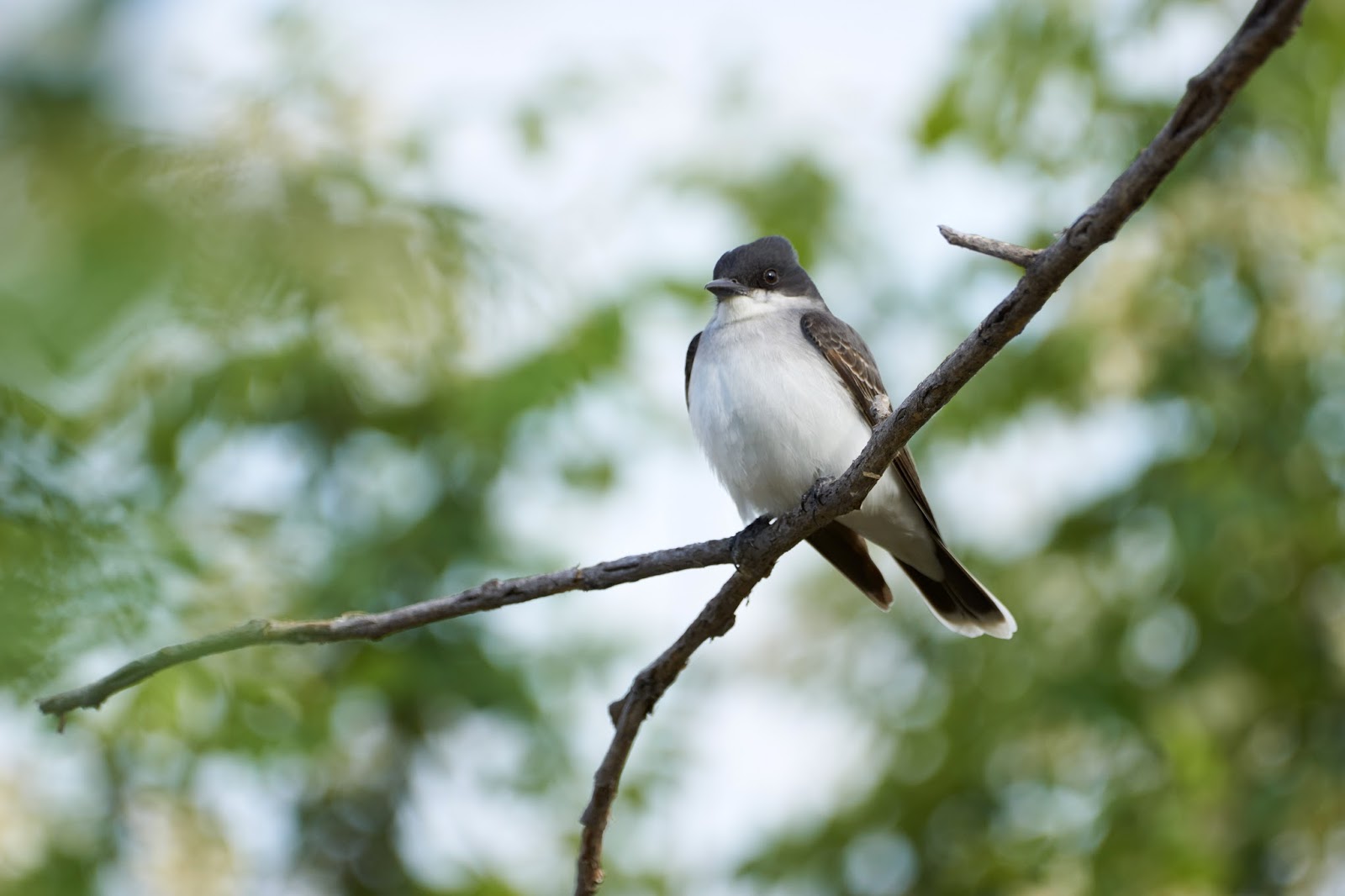
This Eastern Kingbird in the same grove was quite tame, and let me get some nice pics.


After birding a few woodlots, it was time to head to the Big Salt Marsh at the north end the refuge. Here we cleaned up on a lot of shorebirds and waterfowl, including several Sanderling, Dunlin and most of the rest of the "peeps" around right now.


We came upon this American Bittern standing stock-still in the ditch. It was under the impression that it was invisible and slowly backed into the grass.


This Red-headed Woodpecker popped up while we were watching several Bobolinks at the Black Rail field


 A couple of Black-bellied Plovers were a nice addition to the list, and two Whimbrel a bit later were even nicer.


We then hit a couple more woodlots, finding a few more species including Eastern Wood Pewee, American Redstart and Swainson's Thrush.


We also found this caterpillar, I think that it is probably a Variegated Fritillary cat, but I'm not 100% sure on that


The Catalpa Grove
One last swing by the Big Salt Marsh and a nearby Prairie Dog town netted us two Burrowing Owls, a couple Short-billed Dowitchers and a Belted Kingfisher.


Burrowing Owls have got to have about the weirdest flight style of any bird, it's an exaggerated, swooping bounce.

Wilson's Phalarope

We left the refuge with 129 species, below last year but not too bad. We stopped at a few of our regular spots back home to clean up on a few common species we had missed earlier.


This Lark Bunting was a very nice surprise.


This Western Meadowlark sang from a nearby fence post.

Killdeer

I finished the day with 141 species, not bad for this year and enough to have me finish in the top 100 birders for the day in the United States, although just barely, at #98. Anthony also had 141, but Andrew missed out on a few species we saw later and finished up with 136.

All in all, it was a very enjoyable day, and we're definitely looking forward to next year!

Joseph


Tuesday, May 5, 2015

May 5: Quivira and Elsewhere

We hitched a ride to Quivira today with our birding friends Jay and Verna Miller.  It's Verna's birthday and the excursion was Jay's present to her.  They were kind enough to let us go along, and the birding was amazing.

We arrived at about 6:30 and hit the Big Salt Marsh first.  It yielded its usual suspects.  A total of twenty-two species of shorebirds swarmed the flats. Highlights were three Long-billed Curlews, two Snowy Plovers on their nests, a Piping Plover, a Sanderling, a large flock of Willet, eleven Hudsonian Godwits, and more than a dozen Semipalmated Plovers.  The Snowy Plovers put on a show for us as they tried in vain to lead the van off the road and away from their nests (if you can call them that) with a fake broken wing tactic.  I also spotted a Northern Waterthrush near the hay barn on Hay Barn Road north of the marsh, but it flitted back out of sight before the other members of the party could glimpse it.


A Snowy Plover nest which consists of a shallow depression in the gravel: photo by Bryant

A Snowy Plover incubating its eggs: photo by Andrew

This Solitary Sandpiper sat still long enough for us to stop and snap a few pictures before it flew: photo by Andrew

\
This Turkey Vulture, if not a gorgeous bird, was considerate enough to let us get decent pictures of it: photo by Andrew

We spotted this Long-billed Curlew along the Wildlife Drive: photo by Bryant

Apparently the Snowy Plover (flying) was somewhat annoyed by the presence of its close relative, the Piping Plover: photo by Bryant

I managed to capture this photo of an active Sanderling as it scurried back and forth along the shoreline: photo by Bryant


As we worked our way toward the south end of the refuge,  we picked up a few more notable birds, including a Black Tern and vibrant male Rose-breasted Grosbeak- both year birds for Andrew and me.  I also snapped a few pics of this beautiful Forster's Tern as it flew past.  By the time we left Quivira, we had tallied 104 species.


Forster's Tern: photo by Bryant


On our way home, we stopped at a few places along the way and picked up a few birds for our day list, as well as two for our year list: Blue Grosbeak and Western Sandpiper.  


Western Sandpiper: photo by Andrew

This Eastern Kingbird posed on the fence, giving us great picture opportunities: photo by Bryant

When we got home, Andrew and I birded around our place and in Irish Creek to add a few species to our day lists.  We found an excellent variety of migrants, most notably Blackpoll and Wilson's Warblers (which were year birds).  My final day bird, a White-throated Sparrow, put me at 129 species.  That's my third day over 100 within a span of three weeks!  This is certainly the time of year to be out!


Bryant


Tuesday, April 7, 2015

McCown's Longspur!

Yesterday evening I decided to bike over to some alfalfa fields nearby to see if I could find any interesting birds.
 There were dozens of American Pipits flying around, as well as several Baird's Sandpipers looking out of place in the dry field. Before long I heard a longspur flying over. It didn't sound quite right for Lapland (the most common species in the area). As it landed it flashed a mostly white tail with a black "T" pattern. Bingo! Diagnostic for McCown's! This lifer then helpfully flew far out in the field, far out of photography range. I was a bit disappointed that I hadn't got better looks or photos, but then a second McCown's flew in as well! This one was just barely close enough for my camera, but I managed to get some horrible but identifiable pics.

Bryant, Andrew and Anthony showed up a bit later to look for the longspurs, but although we found several Lapland and Chestnut-collared Longspurs we were unable to relocate the McCown's.

A horrible photo, but you can just make out the black "bib" of the McCown's

This morning I returned to the field with Anthony and relocated one of the McCown's, along with many Lapland and Chestnut-collared Longspurs. This time we were able to get much closer and got far better looks and photos.


  American and Sprague's Pipits were also common. A few of them doing their display flights, singing their beautiful song as they soared high above us.

  It isn't surprising that this species is often overlooked! Their secretive nature, choice of habitat (mostly wide open short-grass prairie) and camouflage, makes them very hard to find. 


Sprague's Pipit's are supposedly quite uncommon in the area (and in fact didn't make on to the Reno county list until 2012), but we have found that they are actually quite common migrants in short alfalfa and overgrazed pastures.


First of year migrants are an almost daily occurrence now, with Swainson's Hawk, House Wren, Cliff Swallow, Grasshopper Sparrow, and Upland and Least Sandpipers all making appearances in the last couple of days.


 Eastern Phoebes are back, singing at the top of their lungs.


 As are Vesper (above) and Chipping Sparrows


While winter residents like this American Tree Sparrow, have nearly all left for the summer.


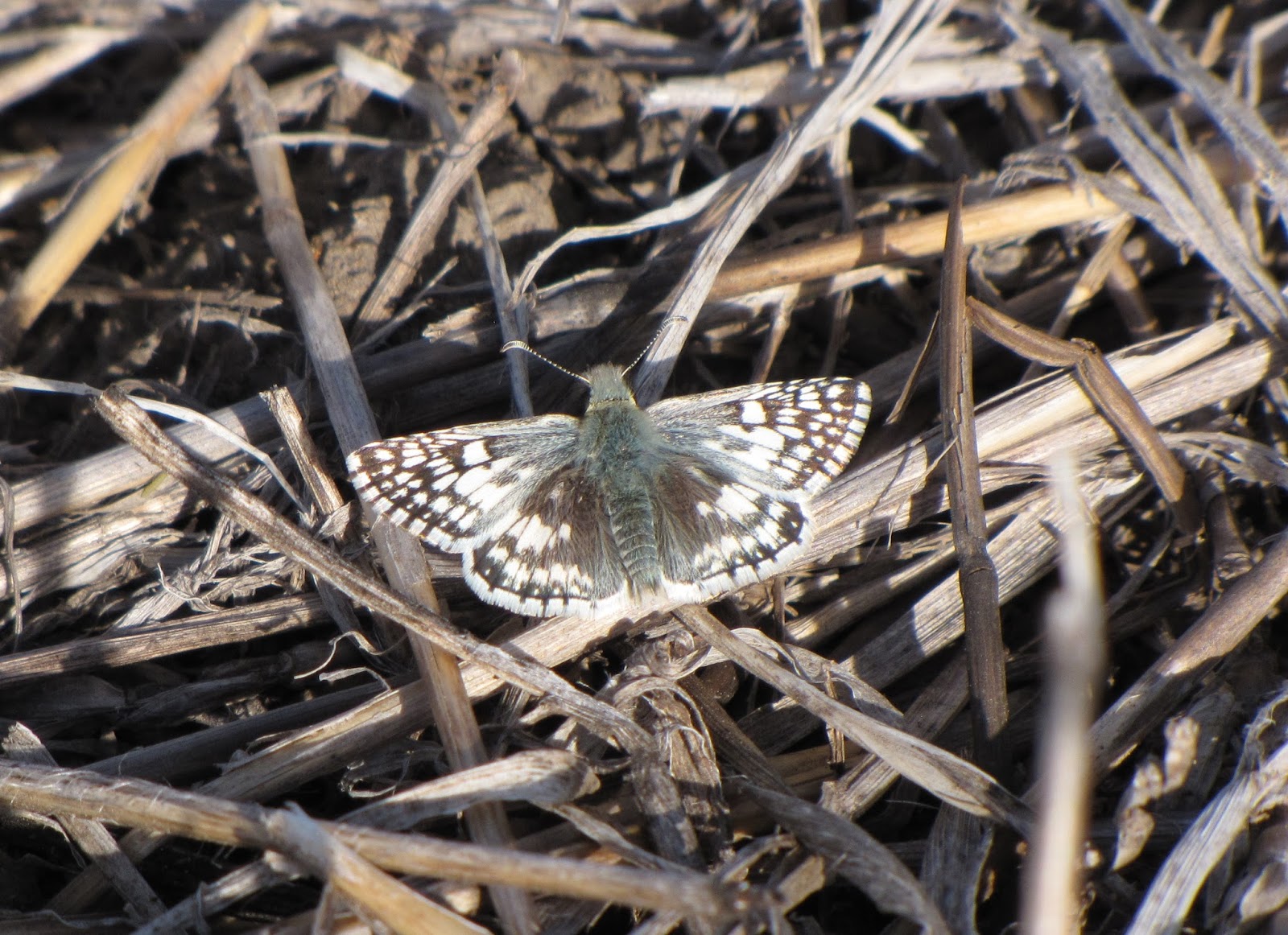
And the butterflies are back! This Common Checkered Skipper was one of several new species for my year list recently.


Joseph