Showing posts with label Rarities. Show all posts

Friday, September 23, 2016

Large Orange Sulphur!

I was surprised when I found a large, whitish sulphur flying around my flower beds this afternoon. It looked similar to a Cloudless Sulphur but was white instead of chartreuse. Knowing it was likely a southern species I made a quick dive for the camera. A few pics and a quick glance at the field guide showed that it was obviously a female Large Orange Sulphur, a species I've had my eye out for for a while.

Large Orange Sulphur female

While far from the first record in Kansas, this is one of the few modern, non-specimen records, so I was pleased to be able to photograph fairly well.


 Unlike the resident Cloudless Sulphurs, it chilled on a Lantana plant the entire time it was present.

 Here's one of the Cloudless (below) for comparison.


Cloudless Sulphur

I've also had a number of Gulf Fritillaries hanging around the yard recently. These are, in my opinion, the most elegant butterfly we get here.

Gulf Fritillary


 Look at those silver spots!


Gulf Fritillary

It was nice to see a rare lep again since this year had seemed a little lacklustre so far after last years amazing stray show.

Keep your eyes peeled, there could easily be more southern species around with the continuing south winds!

Joseph


Tuesday, September 20, 2016

Quick Fall Migration Update: We're still alive!

Hi there,
We have indeed been birding the last few weeks, but what with school starting and all we haven't had much time to post. This post will hopefully bring you up to date on our recent birding adventures


First off, this hummingbird visited my feeder briefly back on August 14. It was only there for a few minutes and I never got great pictures, but it appears to be a Black-chinned Hummingbird. The blunt rounded primary tips are fairly diagnostic for this species and the long bill (visible in other photos) also supports this ID. Perhaps we shouldn't have been surprised, as this was only the next day after the pewee/goldfinch craziness.

Painted Crescent


Moving on, Anthony, Andrew and I visited Quivira NWR on Aug 21. Birding wasn't phenomenal, but we did happen onto a large population of Painted Crescents. Going from never having seen one to suddenly seeing literally dozens was a bit of a shock.

Painted Crescent


Also that weekend, a juvenile Red-shouldered Hawk showed up in my neighborhood and remained for a couple weeks. Central Kansas seems like an odd choice to spend its summer.

Red-shouldered Hawk

Passerine migration finally came to life during the first week of September with a sudden influx of warblers and flycatchers. One particularly good Saturday morning brought a half-dozen species of warblers and a Yellow-bellied Flycatcher to the area.


Black-throated Green Warbler

The flycatcher is moderately rare here, rare enough to be a Kansas Bird Records Committee review species, but not anything you'd drive very far for. Empidonax species can be pretty tricky to ID, but thankfully this one was calling, so we were able to identify it with reasonable certainty.You can listen to my recording of the bird here.

Yellow-bellied Flycatcher. Photo by Andrew


We'll hopefully be birding more regularly in the coming weeks as migration ramps up, so stay tuned for more of our reports from the plains.


Joseph

Saturday, August 13, 2016

Western Vagrants!

Early this morning I went to a local hotspot near Arlington.  Almost right away, I heard what I was sure was a Western Wood Pewee.  I played the call, just to make sure, and it came in and started singing loudly.  Definitely a Western Wood Pewee!  The differences between Eastern and Western Wood Pewees are very slight.  The only way to make a reliable identification is to hear them calling or singing.  Luckily this one was.

First Reno county record of Western Wood Pewee!
 I called Joseph to let him know right away, but he unfortunately couldn't make it till later. The rest of the area was mostly devoid of birds at the time, so I decided to head home for a while.

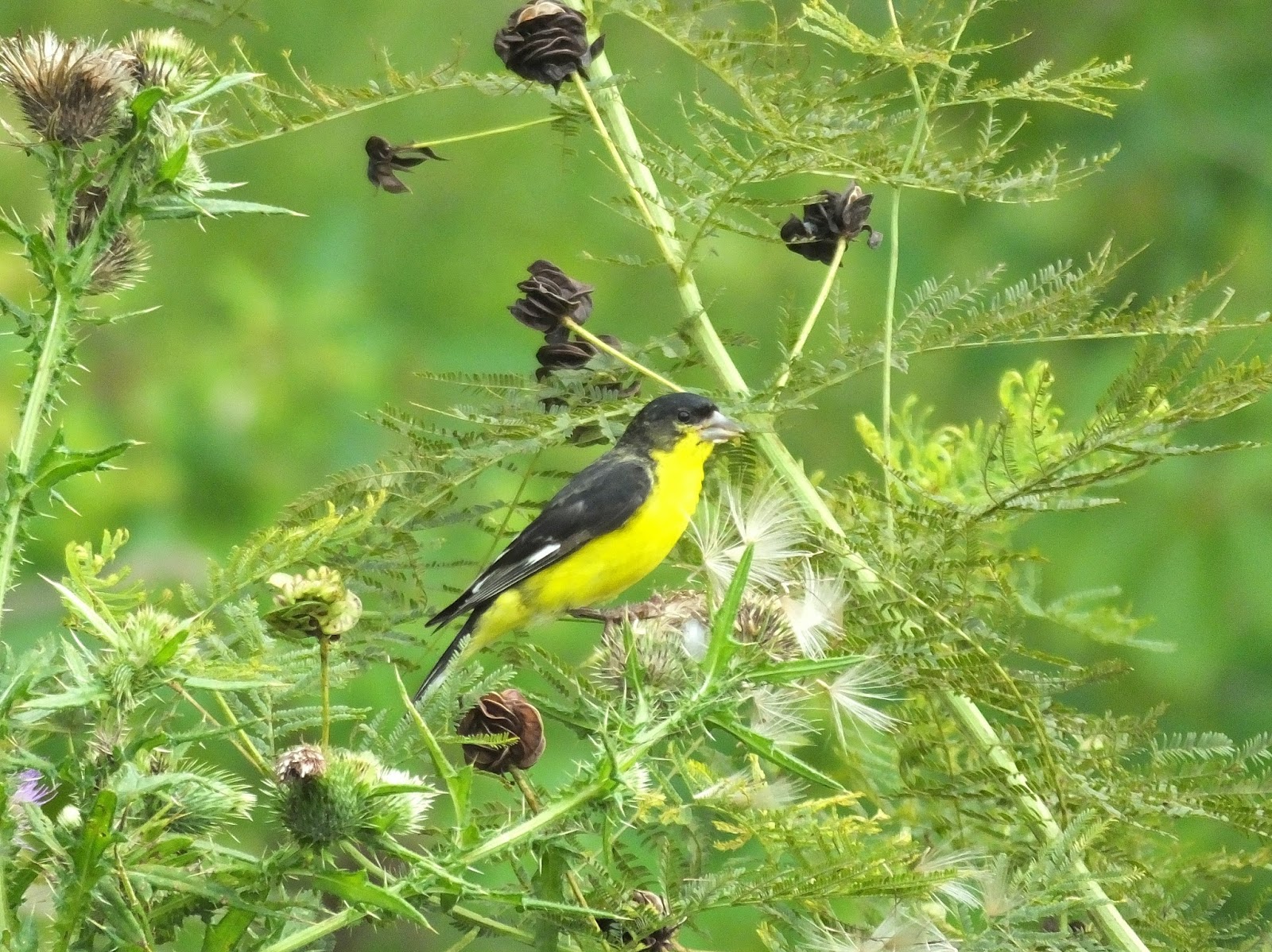
     We decided to meet there again shortly after noon.  Bryant and I got there first, but couldn't locate the pewee immediately.  I started hearing a song that I didn't recognize.  There were several goldfinches hanging around, then one flew in that had wing-bars.  Lesser Goldfinch!  We could hardly believe our eyes.  Just then Joseph, Anthony, and Michael pulled in, and I relayed the information to them.  They covered the distance in remarkably little time and we all managed to see it.

This was the crummy photo I got
  We moved on to try to find the pewee then, and after a little we found it!  It obligingly sang several times and perched out in the open giving us great looks.  It was impossible to get good pics with the harsh light unfortunately though.  We circled around to try to relocate the goldfinch.  Anthony and I got a little closer, but still the pics weren't great. Two review list species in one day!  We haven't had that since last August.

Lesser Goldfinch
Update: I went back on Sunday afternoon and got much better pictures of the Lesser Goldfinch!  The Pewee was still there as well.

Lesser Goldfinch

Maybe some more crazy stuff from the southwest will show up!

Andrew

Friday, June 3, 2016

Monsoon Birding, Laughing Gull and Brown Pelican

With an abnormally wet spring so far, Kansas has been having some odd birds.

A Red Phalarope showed up at Quivira one day last week, so we headed out there Sunday afternoon with a small bit of hope that we would be able to refind it. Long story short, we were a day later and a dollar short, our special feature as usual. We did, however, stumble across a Laughing Gull, not a bad find and a state bird for all of us.

The long lanky wings and large bill are a dead giveaway, even without the other supporting plumage features. Photo by Andrew

On Monday evening the extended family of Andrew, Bryant and I had a Memorial Day picnic at Kingman Lake. I was one of the first there and quickly checked the small lake for anything interesting. I had seen a fairly distant something, driving in, that didn't quite fit for any expected birds, so I checked it out right away. Well, it was a Brown Pelican, that was unexpected. While these are nearly annual in Kansas, (and no longer even a review list species), it was surprising to find one on a small state fishing lake and not one of the larger reservoirs.


It stuck around the rest of the evening but never let us get very close.


These first pics were, yeah, not so great, but thankfully we got another chance when Andrew, Anthony and I returned on Thursday evening. This time, it was chilling on a small island with a small flock of American White Pelicans and allowed us to get within about fifty yards

There we go! Photo by Andrew
The Brown Pelican has been observed feeding successfully by plunge-diving (fide Andrew Burnett), so it may remain for awhile. We won't mind if it does!

Anyway, it seems likely that these birds, (and the Black-bellied Whistling Ducks), were brought in by a large storm system that moved through a couple weeks ago. It may have brought other rarities as well, so keep your eyes peeled!

Joseph


Thursday, May 19, 2016

Quivira Big Day, 2016


May 14th dawned not-so-bright and very chilly on six birders at Quivira National Wildlife Refuge--we were taking part in the annual "Global Big Day" with Barry Jones. We started out at about 6:00 A.M. and slowly collected some of the more common species.The weather for this count was definitely less than ideal, overcast and about 39 F, and we had rather low hopes of beating last years record of 154 species.


 The first good bird of the day was this Olive-sided Flycatcher, not counting the Yellow-breasted Chat and Bewick's Wren that refused to cross the road into Stafford County where we needed them.


 This Tree Swallow teed up nicely beside the road.


 We found a pair of Blue-gray Gnatcatchers in the middle of house construction. Here, the female is just leaving after making a few changes to the structure.


The male wasn't super impressed that we were hanging around and kept scolding at us.


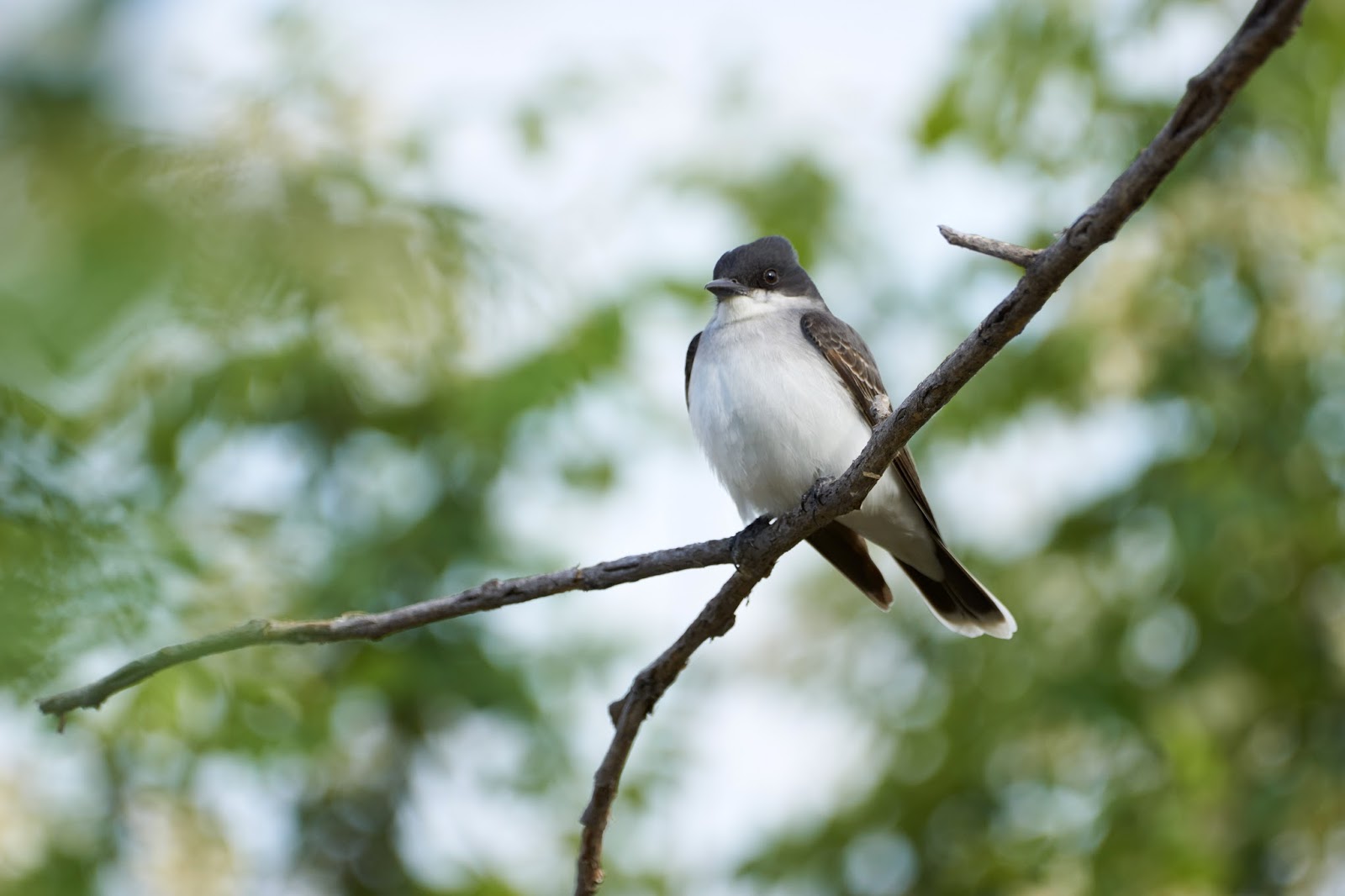
This Eastern Kingbird in the same grove was quite tame, and let me get some nice pics.


After birding a few woodlots, it was time to head to the Big Salt Marsh at the north end the refuge. Here we cleaned up on a lot of shorebirds and waterfowl, including several Sanderling, Dunlin and most of the rest of the "peeps" around right now.


We came upon this American Bittern standing stock-still in the ditch. It was under the impression that it was invisible and slowly backed into the grass.


This Red-headed Woodpecker popped up while we were watching several Bobolinks at the Black Rail field


 A couple of Black-bellied Plovers were a nice addition to the list, and two Whimbrel a bit later were even nicer.


We then hit a couple more woodlots, finding a few more species including Eastern Wood Pewee, American Redstart and Swainson's Thrush.


We also found this caterpillar, I think that it is probably a Variegated Fritillary cat, but I'm not 100% sure on that


The Catalpa Grove
One last swing by the Big Salt Marsh and a nearby Prairie Dog town netted us two Burrowing Owls, a couple Short-billed Dowitchers and a Belted Kingfisher.


Burrowing Owls have got to have about the weirdest flight style of any bird, it's an exaggerated, swooping bounce.

Wilson's Phalarope

We left the refuge with 129 species, below last year but not too bad. We stopped at a few of our regular spots back home to clean up on a few common species we had missed earlier.


This Lark Bunting was a very nice surprise.


This Western Meadowlark sang from a nearby fence post.

Killdeer

I finished the day with 141 species, not bad for this year and enough to have me finish in the top 100 birders for the day in the United States, although just barely, at #98. Anthony also had 141, but Andrew missed out on a few species we saw later and finished up with 136.

All in all, it was a very enjoyable day, and we're definitely looking forward to next year!

Joseph


Tuesday, January 19, 2016

The Butterflies of 2015: A Photographic Review

Since Andrew got the obligatory "2015 review" on birds done, I've taken it upon myself to do the butterfly version.

Simply put, 2015 was a fantastic year for butterflies. I finished with a total of 71 species in Kansas, by far my best ever. But that wasn't the most exciting part. This summer was apparently on of the best for strays in the last 20 years (fide Chuck Ely). We found, in order, a Sickle-winged Skipper (3rd state record, seen by Anthony only), an Arizona Sister (6th state record), a Long-tailed Skipper (3rd or 4th state record, seen by Joseph only), a Tailed Orange (7th state record), and last, and definitely not least, an apparent Purple-washed Skipper Andrew found in their yard. You may recall that we identified it as an Ocola Skipper, the geographically closest Panoquina, in our earlier post about that sighting. However, Dan Jones, of Rio Grande Valley Butterflies, pointed out that the field marks were consistent with the Purple-washed Skippers he sees down there. Any Panoquina would be a first for Kansas, but Purple-washed was completely off our radar!

Sickle-winged Skipper. Photo by Anthony

Arizona Sister. Photo by Joseph

Arizona Sister. Photo by Joseph

Long-tailed Skipper at the Dyck Arboretum in Hesston. Photo by Joseph

Tailed Orange. Photo by Joseph

Presumed Purple-washed Skipper. Photo by Andrew


Presumed Purple-washed Skipper.  Photo by Andrew

Note the small white spot anterior to the large arrowhead-shaped one visible on the far upperwing, this, along with the purple sheen and straight line of dots on the underside of the wing, is apparently fairly diagnostic for Purple-washed.


Red-banded Hairstreak. Photo by Joseph

Surprisingly, I found two Red-banded Hairstreaks in Reno Co this year. They are common in southern Kansas, but seldom come this far north.

Little Wood Satyr. Photo by Joseph

Bordered Patch. Photo by Joseph


Southern Dogface. Photo by Joseph

Melissa Blue. Photo by Joseph

American Snout. Photo by Joseph

Common Wood Nymph. Photo by Joseph

Silver-spotted Skipper. Photo by Joseph

Delaware Skipper. Photo by Joseph


I'm really looking forward to "lepping" this year, and while my butterfly list is currently zero, I hope to get at least 75 species. Now, to go and find some Viceroy hibernacula to get my list started!

Joseph