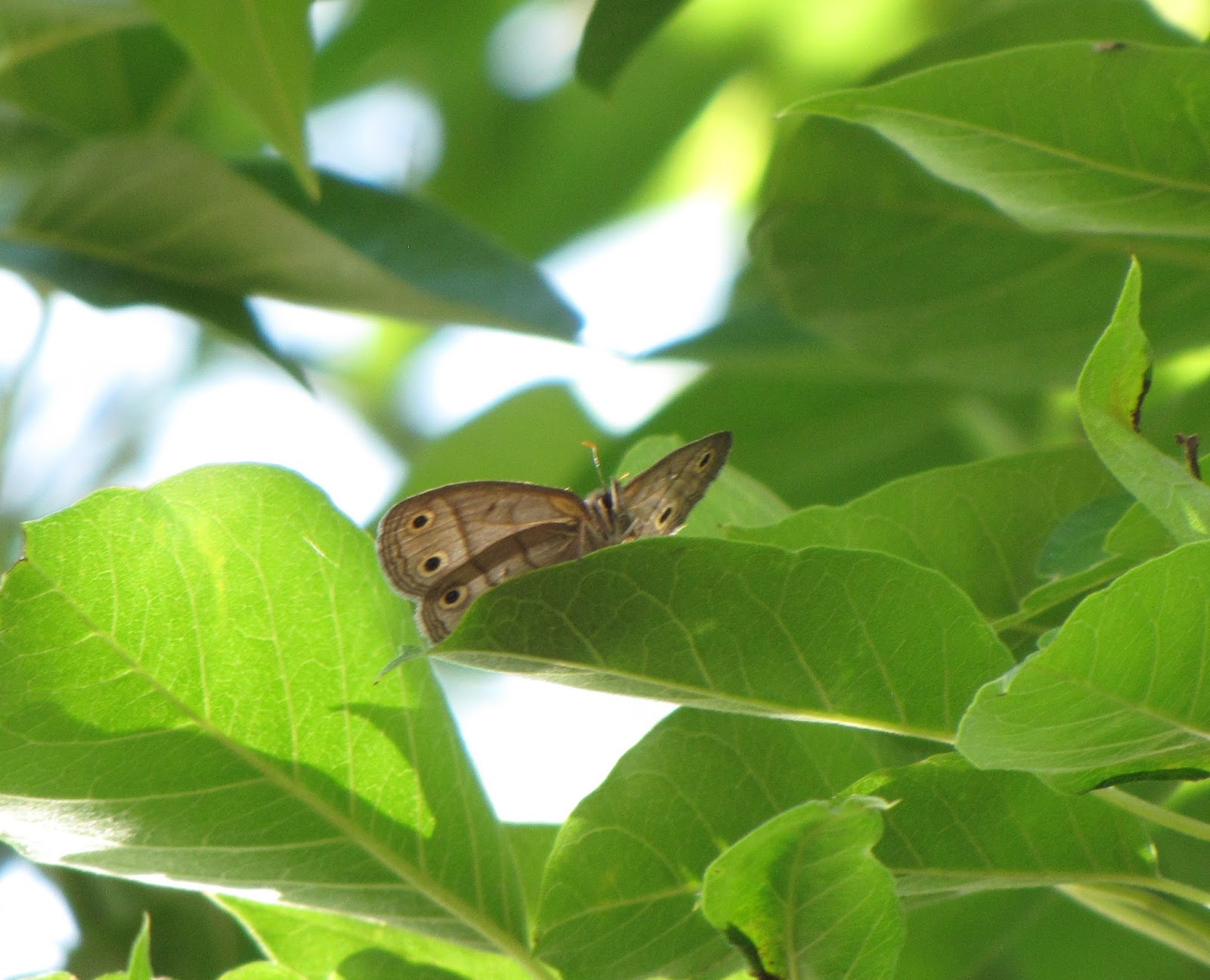
I was planning to go butterflying with Anthony yesterday afternoon, but had some other stuff come up and wasn't able to go after all. He called presently with the news that he had found what he thought was a White Admiral. That would be really remarkable here, so I immediately hopped in the truck and hurried the two miles to where he was. When I saw the butterfly I knew it was not a White Admiral, but some sort of "sister" (Adelpha sp)! I didn't know what species, but no sisters are expected here. Luckily it was very tame and allowed us to get some great photos, confirming it as an Arizona Sister, apparently only the sixth record for Kansas! (per Butterflies and Moths of North America Online, BAMONA for short)

Arizona and California Sisters are very similar. We determined this was an Arizona because of the pale edging all along the back of the white stripe on the hindwing as well as the single orange bar near the base of the wing. A California Sister would have an incomplete pale edge and double orange bars near the wing base. BAMONA staff verified our identification.
This is definitely one of the most beautiful butterflies I've seen. With a 3-5 inch wingspan, it was an impressive sight as it glided slowly around my head, with an occasional flap thrown in now and then.

Anthony and I had also done a little butterflying together after church earlier in the afternoon. Not far away, we found a Red-banded Hairstreak, a species we definitely did not expect here, although isn't nearly as rare as the sister.
 |
| Red-banded Hairstreak |
A couple of weeks ago, Anthony photographed a butterfly he couldn't identify. When he showed me the photo I recognized it as a Sickle-winged Skipper, which I knew would be really rare here. (I honestly didn't even know if they'd been seen in Kansas before.)
 |
| Great pic courtesy of Anthony Miller |
Another butterfly of interest I've seen lately is this Southern Dogface, a really striking sulphur I'd never seen well before.
 |
| I didn't remember they had such stubby antenna. |
They really get flashy in flight, with their bold black and yellow pattern.

If you're thinking about getting into butterflies, now would be a great time to start! As I've mentioned previously, Butterflies of Oklahoma, Kansas, and North Texas is a great reference for learning the butterflies of this area. For more advanced butterfliers, check out the Kauffman Field Guide to Butterflies of North America. I'll end with a shameless plug. If you want to see more of our butterfly (and bird and mammal) photos you can check out our Flickr photostreams. Mine here, and Bryant and Andrew's here.
Joseph