Showing posts with label Sanderling. Show all posts

Friday, August 21, 2015

Cheyenne Bottoms on Thursday

When the cold front brought in the latest rarity at Cheyenne Bottoms, a Pomarine Jaeger, we (Andrew, Joseph, and I) purposed to go chase it the following afternoon if it was seen again.  Well, it turned up again on Thursday morning. And so, we did our duty and fulfilled our purpose.

We arrived at the Bottoms at about 1:30 to find the marsh bustling with bird activity.  We stopped at the observation tower just inside the entrance to get our bearings and scope the marsh a bit.  Our search turned up no large dark birds other than Great Blue Herons, Ibis, and Cormorants.  The Jaeger should have stuck out like a sore thumb.  We did, however, notice a couple of vehicles stopped beside the road up ahead.  After leisurely checking the swallows perched nearby for Cave Swallows (there had been one reported)  we made our way toward the parked vehicles.  After a short conversation with the owners, who happened to be Tom Ewert and Dave Klema, we discovered that the Jaeger had just disappeared out of sight over a dike about a mile out on the central lake.  If only we had hurried over there sooner, we would probably have seen it!  No matter, it could probably be seen from the other side of the dike, and thankfully the road went around the lake giving a view of both sides.  We headed out around the lake, stopping briefly beside a wounded Ring-billed Gull to snap a few pics, and scanning the air and water for a large dark bird (other than Great Blue Herons, Ibis, or Cormorants).  We did; however, manage to find a Neotropic Cormorant, posing nicely on a weed not far off the road.


Ring-billed Gull: photo by Bryant


Neotropic Cormorant: photo by Andrew


Part way around, we met up with Edward Raynor, who had just refound the Common Gallinule (another rarity reported recently).  He offered to try to help us refind it, as well as the Jaeger, and we took him up on it.  We followed him to look for the Gallinule, all the while keeping our eyes peeled for any sign of the Jaeger.  We found neither, and soon headed back around the lake check back where we started.  We had stopped to scan the water, when Andrew said, "I think I've got it!"  We all trained our binoculars on the distant speck.  It looked promising, but unfortunately, it was heading the other direction and soon disappeared from sight.  With our limited views- it was over a mile away- we weren't able to make a positive I.D. although we were all fairly sure that it had been the Jaeger.  Close call number two!

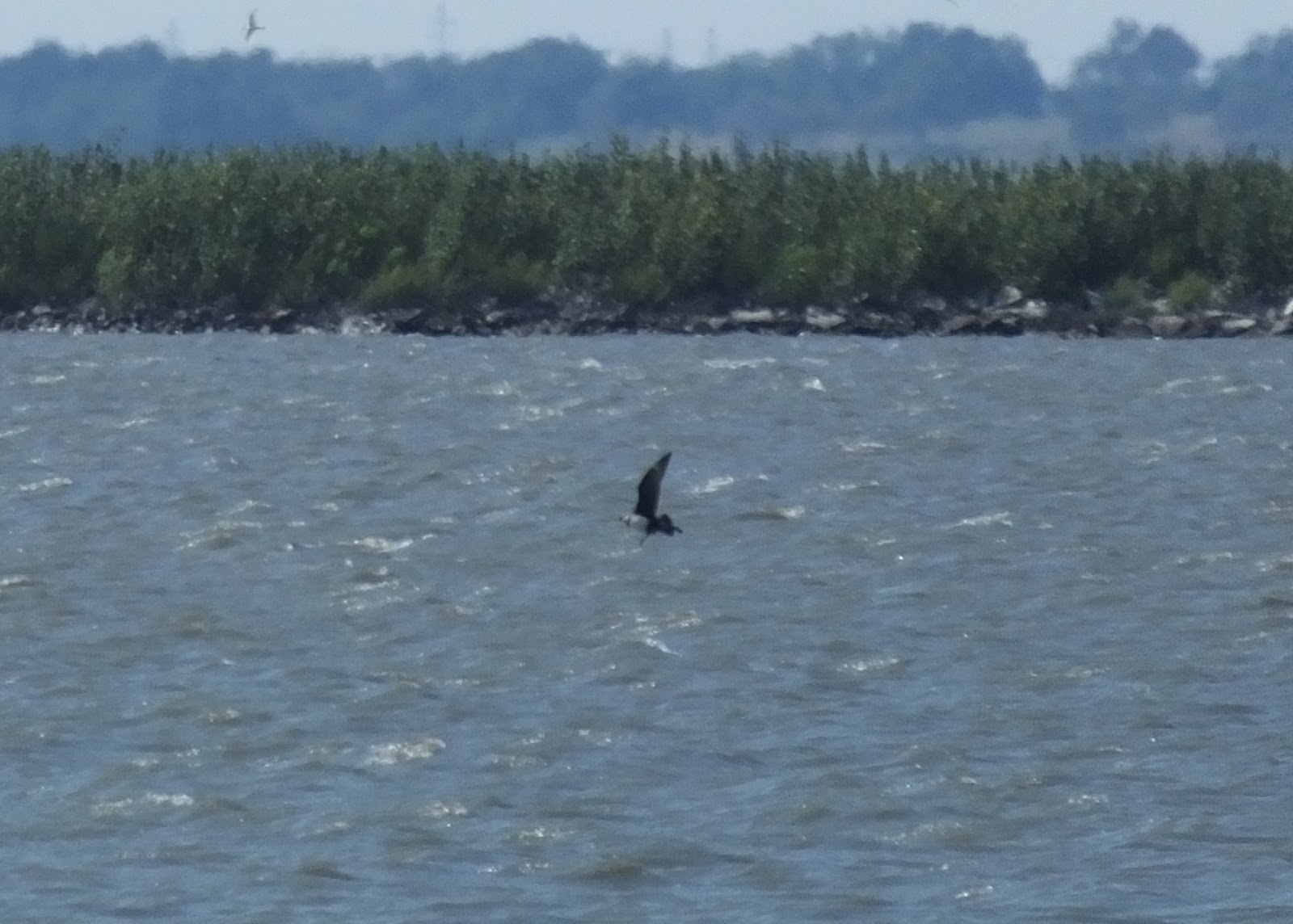
We continued back around the lake, stopping occasionally to scan.  While we did find a Least Bittern, several Buff-breasted Sandpipers, and two Sanderlings, all good finds; the real prize eluded us.  And our time was running out!  It was about 3:30, and we needed to leave by 4:00.  We stopped again (we were now back to where it had first been seen) to talk to some more birders, who told us they had seen the Jaeger about an hour ago from the same place.  It had been back while we were gone around the lake!  While I was still talking to them, Andrew, who had been scanning the lake, sounded the alarm.  Sure enough.  There it was in all its glory, floating on the water about 3/4 of a mile off the shore.  We soon had Edward's scope focused in on it, giving us beautiful looks.  It even took off for us several times, allowing us to see the diagnostic Pomarine paddle-shaped tail.


Pomarine Jaeger: photo by Andrew


Pomarine Jaeger, notice the odd paddle shaped protrusion for the end of the tail: photo by Andrew

What a great finish to a twitch!  It was very gratifying to finally see the crazy critter after several near misses!

Bryant


Tuesday, May 5, 2015

May 5: Quivira and Elsewhere

We hitched a ride to Quivira today with our birding friends Jay and Verna Miller.  It's Verna's birthday and the excursion was Jay's present to her.  They were kind enough to let us go along, and the birding was amazing.

We arrived at about 6:30 and hit the Big Salt Marsh first.  It yielded its usual suspects.  A total of twenty-two species of shorebirds swarmed the flats. Highlights were three Long-billed Curlews, two Snowy Plovers on their nests, a Piping Plover, a Sanderling, a large flock of Willet, eleven Hudsonian Godwits, and more than a dozen Semipalmated Plovers.  The Snowy Plovers put on a show for us as they tried in vain to lead the van off the road and away from their nests (if you can call them that) with a fake broken wing tactic.  I also spotted a Northern Waterthrush near the hay barn on Hay Barn Road north of the marsh, but it flitted back out of sight before the other members of the party could glimpse it.


A Snowy Plover nest which consists of a shallow depression in the gravel: photo by Bryant

A Snowy Plover incubating its eggs: photo by Andrew

This Solitary Sandpiper sat still long enough for us to stop and snap a few pictures before it flew: photo by Andrew

\
This Turkey Vulture, if not a gorgeous bird, was considerate enough to let us get decent pictures of it: photo by Andrew

We spotted this Long-billed Curlew along the Wildlife Drive: photo by Bryant

Apparently the Snowy Plover (flying) was somewhat annoyed by the presence of its close relative, the Piping Plover: photo by Bryant

I managed to capture this photo of an active Sanderling as it scurried back and forth along the shoreline: photo by Bryant


As we worked our way toward the south end of the refuge,  we picked up a few more notable birds, including a Black Tern and vibrant male Rose-breasted Grosbeak- both year birds for Andrew and me.  I also snapped a few pics of this beautiful Forster's Tern as it flew past.  By the time we left Quivira, we had tallied 104 species.


Forster's Tern: photo by Bryant


On our way home, we stopped at a few places along the way and picked up a few birds for our day list, as well as two for our year list: Blue Grosbeak and Western Sandpiper.  


Western Sandpiper: photo by Andrew

This Eastern Kingbird posed on the fence, giving us great picture opportunities: photo by Bryant

When we got home, Andrew and I birded around our place and in Irish Creek to add a few species to our day lists.  We found an excellent variety of migrants, most notably Blackpoll and Wilson's Warblers (which were year birds).  My final day bird, a White-throated Sparrow, put me at 129 species.  That's my third day over 100 within a span of three weeks!  This is certainly the time of year to be out!


Bryant


Friday, May 1, 2015

Quivira on 4-30-15

Bryant, Anthony, and I decided to go to Quivira today for a day of birding. We got there at about 6:30 and went straight to the Big Salt Marsh to listen for Rails. Yellow Warblers and Common Yellowthroats were singing loudly all the while and we even heard a couple American Bitterns doing their unique call.

After a little bit we met up with Barry Jones, the Public Relations person for Quivira, and birded together for two hours.  We made one pass around the Wildlife Drive and saw the following: 6 Dunlin, 2 Sanderling, 3 Black-crowned Night Herons, 2 Bonaparte's Gulls, 15 Hudsonian Godwits, and about 15 Forster's Terns.  Barry then had to go, so we walked up to scope some shorebirds on the flats north of NE 170th street.   People had been seeing a lot of Piping Plovers in the past week, so we thought we had a good chance of seeing one too.  I started to scope the flats with Anthony's spotting scope, but didn't see anything of interest, and we were just about to leave when Anthony said," I think I have a Piping Plover!" Sure enough, I had missed it with a spotting scope, and he found it with binoculars. Sharp eyes!

Sanderling: photo by Bryant
    
Snowy Plover: photo by Bryant

Piping Plover: photo by Bryant

Black-bellied Plover: photo by Bryant
We then proceded to go around the Wildlife Drive a second time a little more slowly, and were surprised to find a breeding plumage Black-bellied Plover and lots of Willets among the many shorebirds.  We were just finishing the second loop and getting very hungry (lunch time!) when I saw a large buffy shorebird with a VERY long bill sitting right across the ditch twenty feet away!  "Long-billed Curlew!" I yelled.  It just sat there as we backed into position and got great pictures.

Long-billed Curlew: photo by Andrew

We decided to recover from the excitement by eating lunch and parked in a nice shady spot beside the road to eat.  During our repast, I happened to glance up and saw a small hawk flying straight north at a fairly brisk pace.  I put my Binoculars on it a was shocked to see that it was a Broad-winged Hawk!  Anthony looked up and saw it, but Bryant could not find it.  Bummer!

We finished eating and went to bird some of the woodlots.  There weren't many interesting birds to be seen there, except a Ruby-throated Hummingbird that only Bryant saw.  We  had seen about 110 bird species by then and so we thought that it would be to fun to see if we could hit 130 in a day, which would be good for April.  We kept working our way down to the Little Salt Marsh, picking up birds as we went.  By the time we got to the Refuge Headquarters, we had a combined 120 species.  We were now really thinking we could get 130 species, so we went out of the way on the way home to pick up some birds we had missed at Quivira. By the time it got dark, I had seen 134 species. What a day!

This Killdeer gave us great looks and picture opportunities as it tried to lure us away from its nest: photo by Andrew

Killdeer: photo by Bryant
Andrew